Author: FLY: Malaysia

  • Technical Analysis

    Technical Analysis

    Technical Analysis

    After learning fundamental analysis which involves analyzing the nature of business and the characteristics of a company, now let’s look at a completely different approach. It is known as the technical analysis. Fundamental analysis and technical analysis are the 2 main schools of thought in the financial markets. They are like siblings when it comes to analyzing financial securities. Sometimes they work together, sometimes they work on their own, and well like all siblings sometimes they quarrel, and by quarrel, it means that they give different opinions. So, let’s dig deeper to find out more about technical analysis.

    Before applying technical analysis, first you have to know what that is.
    [Image from: brainstuck.com]

    Technical Analysis is a method of analyzing securities by looking and gathering information from the statistics generated by market activity, such as past prices and volume. Generally, it is a forecast of future price movements based on examinations of past price movements. Different from fundamental analysis, it used charts and other tools instead of financial statements to identify patterns that suggest future activity. There are different types of technical traders just like there are different types of approaches in fundamental analysis but technical analysis basically revolves within 3 assumptions:

    • The market price discounts everything.

    Technical analysis believes that the current stock price in the market will reflect everything that has occurred to the company based on market efficiency theory where market participants have already reacted on the information they had. This is also part of the fair value approach because all information regarding the company like the fundamentals, economic factors, or future prospects are included in the stock price of the company. Therefore, the stock price is more relevant to form a basis for analysis instead of the financial statements that provide historical values. The price information is then gathered to interpret market movements and predict future movements.

    • Price movements are not random.

    Prices move in trends. There are 3 main trends in technical analysis which are uptrend, downtrend and sideways. As their name implies, uptrend means that in overall, the stock price is moving upwards, downtrend is the reverse of uptrend, and sideways show that the stock price is pretty much stagnant or moving within a certain range. This is pretty straightforward and it is not difficult to spot a trend. Technical analysts often believe that once a trend is formed, the stock price are more likely to follow the trend rather than going against it. This is a useful piece of information when it comes to forecasting future price movements.

    • History tends to repeat itself.

    This might be a term you will find in social science classes but it is an important concept in technical analysis. Prices are repeated because market participants tend to react consistently given the same market stimuli over time. The repetition of price movements due to factors such as market psychology forms patterns in different size and shapes. We called them chart patterns and they are used to analyze market reaction and understand trends. You might not know what a chart is yet but we will get there soon.

    Now, we will move on to the holy grail of technical analysis, which can help you to become a millionaire before you turn 30. Just kidding. There is no such money making mechanism but I will show you the tools used in technical analysis. The most common tool used is charts. A chart is a graphical representation of all the price movements over a period of time. There are 3 different types of charts which are line charts, bar charts and candlestick charts. All type of charts has its own pros and cons but the most common and popular chart among technical traders is the candlestick chart. By the way, these are not the candlesticks you saw in real life!

    Candlesticks and candlestick chart, they really do look like candlesticks in real life!
    [Images from: www.freeonlinetradingeducation.com & blogs.sas.com]

    A candlestick chart is also known as the Japanese candlestick chart as they were used by the Japanese since the 17th century to analyze rice prices. Candlesticks contain data such as the opening price, closing price, highest price, and the lowest price of the day. The image on the upper left shows the 2 main types of candlesticks which are the bullish and the bearish candlestick. If the closing price is higher than the opening price, the candlestick is considered bullish (often shaded green or hollow), and if the closing price is lower than the opening price, the candlestick is considered bearish (often shaded red or black). The image on the upper right shows a typical chart that we will see in all trading platforms nowadays, which consists of many candlesticks in it to record all the previous price movements.

    Meet some of the family members of the candlesticks!
    [Image from: hitandruncandlesticks.com]

    Each candlestick will form different shapes and sizes depending on the four price levels (opening, closing, highest, and lowest) of the stock on a particular day. The image above shows some variations of the candlestick patterns but there are a lot more out there in the market! Different shape and size provide different interpretation and meaning that will affect the decision made by the technical analyst. Some represent bullish behaviour while some represent bearish trends and each with different degrees of strength and momentum. Besides, when two candlesticks come together, they give out different signals as compared to them alone. Below are some examples of what might happen when two different candlesticks come together.

    We humans are known as couple when two of us are together but candlesticks get different names. [Image from: singaporestockstrading.com]

    After learning some brief introductions of technical analysis, it is important to know that there are some critics that view technical analysis as a form of black magic. There are supporters of this approach and there are those who question the validity and the credibility of technical analysis. However, the truth is that technical analysis does work up to a certain extent. Therefore, as an avid investor, we can’t afford to ignore technical analysis totally.

    Although fundamental and technical analysis seemed as polar opposites, many investors have made some great profits by combining the 2 approaches. For technical analysis, we have to master all the chart patterns and other tools in order to have a better profit ratio. We can learn from the success examples and pick up the approach that has a high probability of profit record and those that suit us the most.

    Technical analysis requires clear judgement and years of experience but it is do-able!
    [Image from: www.wealthmanagement.com]


    Download The Report Here:

    [download id=”1869″]

    [tw-toggle title=”References:”]

    Investopedia.com (2006) ‘Technical analysis: The basic assumptions’, in Available at: http://www.investopedia.com/university/technical/techanalysis1.asp (Accessed: 27 January 2017).

    Investopedia.com (2006) ‘Technical analysis: Fundamental vs. Technical analysis’, in Available at: http://www.investopedia.com/university/technical/techanalysis2.asp (Accessed: 27 January 2017).

    StockCharts (2016) Technical analysis. Available at: http://stockcharts.com/school/doku.php?id=chart_school:overview:technical_analysis (Accessed: 27 January 2017).

    Twiggs, C. (2001) Incredible charts: Candlestick charts. Available at: http://www.incrediblecharts.com/technical/candlestick.php (Accessed: 27 January 2017).

    [/tw-toggle]

  • An Economy for the 1%?

    An Economy for the 1%?

    Inequality – A shocking revelation

    According to Oxfam report, the combined wealth of the world’s 8 richest men: Bill Gates, Warren Buffett, Carlos Slim, Jeff Bezos, Mark Zuckerberg, Amancio Ortega, Lawrence Ellison and Michael Bloomberg is equal to that of the poorest half of the world’s population. While this alarming figure is astonishing to many, income inequality is not an unheard-of-phenomena. In fact, we could see it coming. It has been brought up to the attention of public throughout the years, but were disregarded by some as hoax. For instance, Christine Lagarde’s effort to raise concerns over inequality was in vain and faced backlashes from economists back in Davos 2013.

    Other findings of the report showed that since 2015, the richest 1% has owned more wealth than the rest of the planet. While the income of the poorest 10% has increased by less than $3 a year between 1988 and 2011, the income of the richest 1% has increased by 182 times as much. A Financial Times Stock Exchange 100 CEO earns as much in a year as 10,000 people working in garment factories in Bangladesh. In developing countries, income inequality which is measured by Gini Coefficient, shows a more disconcerting situation. In Vietnam, the richest man in the country earns more in a day than the poorest person earns in 10 years. The wealth of the rich is growing at an unprecedented rate. It is predicted that we will witness the first trillionaire in 25 years’ time. This suggests a far greater income gap, which can be devastating for the economy if no concrete effort is done to address the underlying problem.

    Why the rich get richer while the poor get poorer?

    Riches are increasingly concentrated in the hands of few, perpetuated by the unequal distribution of power within a capitalist society. The rich are fueling the inequality by evading taxes, suppressing wages, and influencing policy making.

    The rich and big corporations actively seek ways to evade and dodge taxes. While the two terms are often misused interchangeably, they have distinct differences. Tax dodging refers to the legitimate way of sheltering income from taxes, whereas tax evasion involves illegal act of minimizing taxes paid. The Panama Papers, which exposed more than 214,488 offshore entities illustrates how the rich use tax havens for their own economic benefits. The John Doe who leaked the Panama Papers, documents cited income inequality as the reason for his action, that ‘because he understood enough about their contents to realise the scale of the injustices they described’(BBC, 2016). In developing countries, $100bn are lost each year to tax avoidance, which can be used for health care, education and other welfare to improve the lives of millions (Crivelli et al., 2015)

    Besides, corporations are motivated to pay out large share of its profit to its shareholders, driven by their goal to create greater shareholder value. In UK, 10% of profit were returned to shareholders in 1970 but in recent years, this figure has grown to 70% (Purpose of Corporation, 2016). Among the shareholders, majority are the rich, while institutional investors representing the less wealthy and working class like pension fund own only insignificant shares. Who benefits from this? Again, it is the rich. This cycle of transferring wealth from the rich to the rich has done nothing but widened the income gap.

    The rich have also utilized their economic power to suppress wages of working class in order to reduce cost. This answers the question of the increasing gap between the rich and the poor. The International Labour Organization estimates that 21 million people are forced laborers, who generate an estimated $150bn in profits each year (Wheelwright, 2016). Those whose labor are used to generate profit, are not given their fair share of income while those at the top walk away with the fruits of their labor. This is the reality of our society—a population that adopts an economic system that funnels wealth to the rich at the expense of the poor.

    The economic power of the rich is so vast that is enables them to influence political outcome. For instance, Charlos Slim controls approximately 70% of all mobile phone service and 65% of fixed lines in Mexico, which contribute 2% of the country GDP. This enables the ultra-rich who have control over great amount of resources to pressure the government and policy makers into making policy which favor them. The policies are therefore rigged at the expense of the poor and powerless. Alphabet, in particular, is one of the biggest lobbyists in Washington and has been in constant negotiation in Europe over anti-trust rules and tax. Smaller businesses, on the other hand, struggle under the monopoly power of giant corporations. Therefore, far from trickling down to the those who need it most—the income and wealth are being sucked upwards at an alarming rate. Once a fortune is accumulated, it develops a momentum of its own. When you are rich, it seems harder to get poor given the ability to keep the ball rolling in acquiring wealth: you get to acquire the best investment advice and possess the economic power to monopolize and manipulate, while the poor fall deeper into poverty.

    The Implication

    Quoting from President Obama, a world where 1% humanity controls as much wealth as the bottom 99% will never be stable. Inequality which is trapping hundreds of millions in poverty has resulted in increased crime and insecurity, and is a threat to social stability. Wage stagnation, insecure jobs, and a widening gap between the rich and the poor have led to disillusionment with mainstream politics. The events of Brexit and Donald Trump’s reign show the public’s effort to overthrow the establishment due to their loss of confidence in the existing political and economic establishment.

    The Cure

    Winnie Byanyima, Executive Director of Oxfam International believes that the millions of people who have been left behind by the broken economies need solutions, not scapegoats. In fact, three quarters of extreme poverty can be eliminated using existing resources (Hoy & Sumner, 2016). In the light of that, Christine Lagarde, echoed by Richard Baldwin, professor of International Economics at the Graduate Institute of International and Development Studies in Geneva, called for redistribution of wealth. Joe Biden reinforced that there is an urgent need for the implementation of a progressive and equitable tax system where everyone pays their fair share. ‘The proceeds of business activity should go back to those who enabled and created them’, said formal vice president of the United States.

    However, merely taking from the rich and giving to the poor does not promise sustainability as it does not address the fundamental problem underlying income inequality. There is a need for a pro-growth approach which invigorates the middle class by creating a favourable environment for making money. The middle class has been the engine for growth, but it is being hollowed out, per Joe Biden. He suggested that the U.S. government could, and should, pay for college to help advance people in their careers. In addition to addressing income inequality, there is an indispensable need to address gender pay gap. Women constitutes a large proportion of the lower income group. For each dollar men earn, women earn only 79 cents (Sahadi, 2017). Therefore, the society should work hand in hand to dismantle barriers to women’s economic progress by improving their competency.

    To curb the problem of tax avoidance through tax havens, government should promote cooperation, instead of competition, in terms of providing lower corporate tax. A new global consensus needs to be reached to ensure corporations and rich pay for their fair shares of taxes and maintain reasonable wage rate of labour.

    Creating an economy for the 99%

    Economic growth ought to be inclusive to ensure its sustainability. Economic progress is about attaining shared prosperity, instead of few thriving at the expense of the rest. The economy has enough resources for all. Careful management and allocation that work in the interest of everyone, is indispensable, so that the proceeds of growth are distributed fairly, not just to those who have the power to control and manipulate them.  

    GINI Index by Countries

    Source: http://data.worldbank.org/indicator/SI.POV.GINI

    Download The Report & Infographic Here:

    [download id=”1833″].

    [download id=”1835″]


    [tw-toggle title=”References”]

    BBC News. (2017). Panama Papers: Source breaks silence on Mossack Fonseca leaks – BBC News. [online] Available at: http://www.bbc.com/news/world-latin-america-36232142 [Accessed 25 Jan. 2017].

    Crivelli, E., De Mooij, R. and Keen, M. (2015). Base Erosion, Profit Shifting and Developing Countries. 1st ed. [ebook] IMF. Available at: https://www.imf.org/external/pubs/ft/wp/2015/wp15118.pdf [Accessed 25 Jan. 2017].

    1. Wheelwright. (2017). Technology news, features and analysis from Guardian US | The Guardian. [online] Available at: https://www.theguardian.com/technology/2016/sep/26/tech- news-lobby-election-taxes-tpp-national-security [Accessed 25 Jan. 2017].

    Hoy, C. and Sumner, A. (2016). Gasoline, Guns, and Giveaways: Is There New Capacity for Redistribution to End Three Quarters of Global Poverty?. [online] Center for Global Development, p.433. Available at: http://www.cgdev.org/sites/default/files/gasoline-guns-and-giveaways-end-three- quarters-global-poverty-0.pdf [Accessed 25 Jan. 2017].

    Purposeofcorporation.org. (2017). News – Behind the Purpose of the Corporation infographic – Purpose of the corporation. [online] Available at: http://www.purposeofcorporation.org/en/news/5009-behind-the-purpose-of-the- corporation-infographic [Accessed 25 Jan. 2017].  

    Sahadi, J. (2017). 6 things you need to know about the gender pay gap on Equal Pay Day. [online] CNNMoney. http://money.cnn.com/2016/04/12/pf/gender-pay-gap-equal-pay-day/v

    [/tw-toggle]


  • Life Insurance Planning

    Life Insurance Planning

    Life Insurance Planning

    What is Life Insurance?

    Life Insurance is one of the least monitored and most misunderstood area of personal finance. Due to its’ endless jargons and its’ close associations with unpleasant scenarios, such as death, disability, and diseases, life insurance can be unpleasant to talk about and may seem less appealing compared to other investment-related topics. However, it is essential to recognise life insurance as a proper foundation to sustainable financial planning. Basically life insurance serves as a protection against financial losses in the event of death, disability and diseases (3D’s). Insurance companies will pay huge amount of money ( i.e. coverage or benefits ) if 3D’s happen in exchange of relatively small amount of money ( premium ) paid to them in consistent times.

    Understanding The Different Types of Life Insurance and Coverage

    There are plentiful of life insurance products out there being marketed to accommodate to different needs and wants. One key characteristic to distinguish life insurance is the type of risk they cover. Almost all life insurance covers against death and disability, but not all life insurance covers against diseases. Critical Illness Policy is one such life insurance, where the coverage includes policyholder being paid one lump sum in the event of being diagnosed with one of the 36 listed critical illnesses. On the other hand, medical insurances cover hospital bills and expenses, mitigating cash outflows and insuring the policyholder from huge financial losses arising from hospitalization.

    On the other side of the spectrum are the savings plan. Despite the fact that these life insurance products offer comparatively lower protection against 3Ds, they are mainly designed to enforce discipline savings and often offer higher returns in premium. Life insurances can also be distinguished by the duration they are enforced. Whole-Life plans covers for an entirety of one’s life, whereas term life insurances are usually enforced for a limited period of time, up to 30 years.

    Why Do We Need Life Insurance?

    If you’re the breadwinner, life insurance makes sure breads get put on the table, mortgage gets paid, your children’s education gets funded even if the worst happens to you. If you are not immune to all diseases, a medical insurance ensures your savings are safe from being emptied overnight by the hospitals.

    If you’re a business owner, a life insurance can be structured to fund a buy-sell agreement to ensure that the remaining business owners have the money to buy your company interests if you unfortunately faced with death or total disability. In this case,the business sustains and your family gets the money from the transfer of ownership. If you desire to leave a huge legacy for your next generation, life insurance ensures this legacy exists by paying the creditor-proof death benefits to your children.

    If you are a property investor, a life insurance can act as your mortgage insurance so that your loan gets approved more easily. If you are planning for retirement, savings plans are an alternative way to ensure a consistent stream of income in the later years.

    The point is, life insurance can cater needs in a lot more ways most people think it does. With the rate of medical inflation between 10% to 15% every year, medical insurance is expected to be ever more crucial as time passes. We are still far away from being a well-insured community. It is found that only half of the Malaysian population had life insurance protection in 2015, with 90% of this half being underinsured. This is a far cry from our neighbouring country Singapore, with an average of 2.5 policy enforced per person.

    How High of a Coverage Should We Secure?

    Coverage benefits are the money policyholders will claim when stricken with death and disability. The optimal amount of this benefit varies for each individual and changes from time to time, depending on commitments. To identify your coverage, identify the total money needed to sustain you and your family once you are financially disabled, minus the total savings and investments you own. This amount of money is the shock absorber that is expected to shield you financially from the worst of rainy days. It is necessary to keep track of this amount consistently, as financial commitments of an individual are always changing and, whenever possible, factor in inflation into the calculations.

    ( Financial Commitment Needed per Month x Number of Months For Recovery ) – Total Savings & Investments = Coverage Benefit

    For critical illness protection, the figure ought to be around 3 to 5 times your annual income as that is the typical period a person diagnosed with critical illnesses need to fully recover and return to employment. On choosing medical insurance, take note of annual limits and lifetime limits, as they are caps on how much you can claim per year and per lifetime. Some medical insurances also impose deductibles, a specified amount the policyholder must pay before the insurance company will pay a claim.

    What to Do When Buying Life Insurance?

    Don’t lie. Being dishonest about your health conditions and lifestyle may void your insurance contract and have you inaccessible to the much needed claim if a crisis arises. Make sure your life insurance agent performs the duty to ask and submit your health details as well. Any agent that encourages you to lie should be reported to the insurance company immediately. Next, understand that most of the time the cash values indicated on the sales quotation are not guaranteed. Although there are plentiful of sales agents out there, one agent can still be more qualified than another. Your insurance planning can be made substantially easier with agents who exhibit more professionalism and expertise. Ensure that the product recommended suits your need and circumstances, do not hesitate to communicate openly with your trusted representative. Last but not least, most insurances, especially medical insurance are best bought when one is healthy. Medical conditions and histories may cause you to be unqualified from purchasing life insurance for a lifetime.

    [tw-toggle title=”References”]

    Lim, H. (2016). BNM hopes to see 75 pct of Malaysians covered by insurance by 2020. [online] Borneo Post Online. Available at: http://www.theborneopost.com/2016/09/30/bnm-hopes-to-see-75-pct-of-malaysians-covered-by-insurance-by-2020/ [Accessed 17 Nov. 2016].

    De Alwis, I. (2015). Planning for healthcare costs in retirement. [online] The Star Online. Available at: http://www.thestar.com.my/business/business-news/2015/10/04/planning-for-healthcare-costs-in-retirement/ [Accessed 17 Nov. 2016].

    Life insurance data 2015 (2016) Available at: http://www.mas.gov.sg/~/media/resource/data_room/insurance_stat/2015/Life%20Insurance%20Data%202015.pdf.

    Malaysian Digest (2016) 90 per cent of life-insured Malaysians under-insured, says LIAM. Available at: http://malaysiandigest.com/news/600094-90-per-cent-of-life-insured-malaysians-under-insured-says-liam.html [Accessed 17 Nov 2016]

    [/tw-toggle]

  • Investing in Education

    Investing in Education

    Investing in Education

    1 Introduction

    Source: Pinterest

    I am sure at some point in life your grandma has nagged you on how you must focus on your studies before anything else. This is because the older generations know well, that education is essential towards a better future. Hence, much emphasis is being placed on your academic achievements, a phenomenon commonly noticed in Asian countries. Investing in education will definitely yield benefits, whether in monetary terms or social terms. Even though cost on education were to be forged out initially, it will definitely be worth it in the long term.


    2 Monetary Benefits

    Source: Department of Statistics Malaysia, 2016

    The chart above shows the median and mean monthly salaries and wages of employees by educational attainment in Malaysia. It shows a strong positive correlation between education level and monthly salary received for an employee. (Department of Statistics, 2016)

    The reason being this is that people with higher education will most likely end up in jobs that requires a specific set of skills. For instance, an accountant. You will not expect a company to hire a random SPM leaver to be an accountant as they do not possess the skills required to handle the profession. In the job market, these people only take up a small portion of the total pool of applicants and the demand for them usually exists. Therefore, economics 101 will tell you that the wages needed to hire them will be high.

    On the other hand, jobs that require little to no specific set of skills acquired from education will most likely to have lower wages. This is due to a large portion of candidates available in the job market which leads to lower pay as there are people that are willing to work for the same price while possessing the same qualification. Besides, the turnover rate for these jobs will be high too. Example of jobs that fall into this category are construction workers, general clerks, receptionists etc.

    3 Personal Development

    Education will also enhance an individual’s personal development process. Arthur Chickering’s Seven Vectors of Development highlight the developmental projects that students face during their undergraduate level of study. The seven vectors are developing competence, managing emotions, developing autonomy, establishing identity, freeing interpersonal relationships, developing purpose, and establishing integrity.

    These 7 vectors are usually suited for undergraduate students due to the high chances of getting repeated exposure to an appropriate development environment, which is actually college or university life. If an individual were to be involved in education, it is more likely that that individual will be more developed than its less-educated counterpart. (Chickering, 1969)

    To put it in context, a university student will have a softer approach of dealing with their future boss during arguments (managing emotions) and will be more likely to be adaptable to the harsh, cold adult world (establishing integrity).

    4 Social and networking advantages

    Enrolling in education will also mean that you will be more knowledgeable and will have more topics to say in a conversation. In this case, you are more likely to match topics with a complete stranger and develop a relationship from there.

    Besides, you will get to socialise with peers that might be beneficial in your future. Have an interesting idea that could be well-developed? Have difficulties in visualising what the future lies ahead? These people will be there to assist you out of the dark trench.  (Queano, 2016)


    5 Conclusion

    In short, investing in education will lead to various benefits that can be exploited by an individual into their advantage. As mentioned above, an investment in education will require an upfront payment (for tuition fees etc), which may be burdening for certain individuals. Although so, there are various ways available to finance for an education, which will be covered in one of our later reports. Hereby is a quote that reminds us that even though there will be difficulties and hardships in our journey in education, we will eventually be able to enjoy success if we work hard enough.

    “The roots of education are bitter, but the fruit is sweet”

    -Aristotle

    Download The Report & Infographic Here:

    [download id=”1530″]

    [download id=”1532″]

    [tw-toggle Title=”References“] 

    Behrman, J. R. & Stacey, N., 1997. The Social Benefits of Education. [Online] Available at: https://www.press.umich.edu/15129/social_benefits_of_education [Accessed 16 October 2016].

    Chickering, A., 1969. Arthur Chickering’s Seven Vectors of Development. [Online] Available at: http://www2.clarku.edu/undergraduate/parents/chickering.htm [Accessed 16 October 2016].

    Department of Statistics, M., 2016. Department of Statistics, Malaysia. [Online] Available at: https://www.statistics.gov.my/index.phpr=column/pdfPrev&id=czRyNkJIbDFyYXJFbU5YTVJ1V1BHZz09 [Accessed 16 October 2016].

    Queano, S., 2016. Professors House. [Online] Available at: http://www.professorshouse.com/why-education-is-important/ [Accessed 16 October 2016].

    [/tw-toggle]

  • 2008 Financial Crisis Summarized

    2008 Financial Crisis Summarized

    Crisis unveiled

    The 2008 Financial Crisis is the worst economic disaster since the Great Depression of 1929. It had inflicted profound damage on US financial system and economy. From October 1, the S&P fell 251 points, losing 21.6% of its value in just nine days’ time. The financial market experienced the largest percentage drop in the history of Dow Jones Industrial Average during the week of October 6 to October 10. This was unprecedented in history and was worse than any single week in theGreat Depression. The crisis spread rapidly beyond US border and became a global crisis. (See also: The Asian Financial Crisis 1997 Explained)

    The long-term implication of the crisis? Millions in America and all over the world has lost their homes. Jobs were lost, with 2.6 million total job losses in 2008, making the biggest annual loss since the end of World War II. Life savings of ordinary Americans fell to a fraction of its value. As of today, a large volume of troubled mortgages remained in place and there is still evidence of the aftermath of the crisis in the US as well as global economy. The crisis has uncovered fundamental flaws in the free market system and was a wake-up call to all.

    The bubble in making

    In March 2001, America went into recession following the bursting of the dot-com bubble. As an effort to save the economy, the federal fund’s rate was lowered 11 times, from 6.5% in May 2000 to 1.75% in December 2001. Low-interest rates and tax cut saved the economy from deeper recession, but only by replacing the dot-com bubble with another bubble, the housing bubble. The housing market prospered due to the high liquidity of the market and easy credit. There was excessive borrowing to fund the purchase of the house. The mortgages were repackaged into collateralized debt obligations (CDOs) which were sold to investors. These highly profitable mortgage-backed securities created demand for more mortgages, prompting the banks into making subprime loans. Subprime loans, which are also called NINA loans, are loans made to borrowers with low credit ratings (No Income, No Asset). These subprime mortgages which have the high risk of being defaulted were backed with credit default swap which insures the buyers against loan default. With that, the supposedly risky CDOs were transformed into AAA-rated products, which made them safe enough to be held by a pension fund. The ability to buy a house with no down payment fed the American dream but created a time bomb that could trigger the most devastating economic turmoil.

    The bursting of bubble

    The decline of house prices had resulted in the default on loans and devaluation of housing-related securities. When the mortgage market which was built upon the subprime mortgage collapse, so did the entire financial market.  In September 2008, major entities in the US such as Lehman Brothers, Merrill Lynch, Goldman Sachs and Morgan Stanley either failed, buyout or bailout (BBC, 2008). Fannie Mae and Freddie Mac were taken over by the federal government and insurance giant like AIG failed to honour the swaps.  In October 2008, the Emergency Economic Stabilization Act was signed into law following a $700 billion emergency bailout of the banking system.

    The effects of the 2008 Financial Crisis

    The crisis spread to other parts of the world due to the highly intertwined global financial market. US$ 2.5 trillion of government debt and troubled private assets were purchased by the Federal Reserve and European Central Bank, resulting in the largest liquidity injection into the credit market and the largest monetary policy action in world history. It had triggered the popping of real estate bubble in Spain and United Kingdom as well as the collapse of Iceland banking system. Other parts of the world were not spared from the onslaught of the crisis and suffered from the collapse in global demand. Developing countries suffered from the fall in remittances and capital inflow.

    The impending doom?

    Looking into factors that have contributed to the crisis, it is easy to notice its strange similarity to those happened in the past. Deregulated market awash in liquidity, low-interest rates and lax credit system was a toxic combination which could bring down the whole economy. It was a textbook case that was not only predictable but also predicted. Can we not notice that? Taking the word of Joseph E. Stiglitz, the greatest surprise about the 2008 economic crisis was that it came as a surprise to many. So perhaps the problem lies not in knowing whether the bubble will pop, but when it will pop. While many may have noticed the bubble that we lived in, few was able to leave the market just in time before the first domino started tumbling down in the housing market. The financial crisis of 2008 has reiterated the importance of regulation of the financial system. 

    Therefore, regulation such as the Dodd-Frank Wall Street Reform Act and the Basel III capital and liquidity standards which regulate the financial market need to be adopted to prevent the likelihood of a future economic crisis. As the boom and bust of the economic cycle continue, there is a chance that some new bubbles will replace the housing bubble, just as how the tech bubble was replaced by the housing bubble. The UN has warned of the impending crisis which may include huge debt defaults among developing countries in its annual report on Trade and Development. So, what is next? Have all the lessons we learnt from the past lay a foundation strong enough for the economy to avoid and withstand another major hit? We will see.

    Download The Report Here:

    [download id=”457″ template=”The 2008 Financial Crisis Summarized”]


    [tw-toggle title=”References “]

    BBC (2007). BBC NEWS | Business | Timeline: Sub-prime losses. [online] News.bbc.co.uk. Available at: http://news.bbc.co.uk/2/hi/business/7096845.stm [Accessed 4 Nov. 2016].

    Goldman, D. (2016). Total 2008 job loss: 2.6 million – Jan. 9, 2009. [online] Money.cnn.com. Available at: http://money.cnn.com/2009/01/09/news/economy/jobs_december/ [Accessed 6 Nov. 2016].

    Trade and Development Report. (2016). In: United Nations Conference on Trade and Development. [online] New York: United Nations Publication, p.218. Available at: http://unctad.org/en/PublicationsLibrary/tdr2016_en.pdf [Accessed 6 Nov. 2016].

    [/tw-toggle]


    Further reading

    Bailouts Will Lead To Rough Economic Ride

  • Bonds

    Bonds


    In the financial world, bond is one of the most common investments made by investors. The ‘bond’ mentioned here is different from the one you have seen on the big screen played by Daniel Craig although they all served as a last name. Government bonds, treasury bonds, and corporate bonds just to name a few. You might even come across the term “bond investing” when you flipped through financial news or books. However, bond remains a mystery to many investors. By definition, a bond is a debt instrument that an investor lends money to an entity who borrows the funds for a specific period of time at a fixed or variable interest rate. Well, anyone can quote the definition of something without knowing any further details of it. So now, we will explore and look deeper to find out what a bond really is.

    “Hi, I’m Bond. James Bond. Oops! Sorry. Wrong ‘bond’. It’s Treasury bond.” [Images from: www.youtube.com & www.wsj.com]

    Do you still remember the pizza company that we built together during our discussion on stock? At the initial stage, we gathered a few partners to fund our company and in return we gave them a share of the company. For bonds, we raise capital through debt instead of equity. This means that we issue bond certificates to the investors stating that we will payback their investments plus at maturity date. The whole process looks like a loan just that the fund providers are investors instead of banks. We will then use the additional capital to fund for activities such as expansion or other capital projects. The bonds we issued are known as corporate bonds. There are a few different names for bonds. Their names are based on who is the issuer of the bonds. For example, government bonds are issued by the government and municipal bonds are issued by states and municipalities, and corporate bonds are given by corporations.

    You will learn a few new words when it comes to bond investing. The first term is face value. Face value is the amount of being loaned by the investors which represents how much the bond worth at its maturity. Besides that, face value also used to refer as the amount the bond issuer to calculate the interest payments. Interest payments from bonds are known as coupon payments. Coupon payments are calculated based on the coupon rate which is the interest rate that the bond issuer agreed to pay on the face value of the bond. Usually, coupon payments are made semi-annually. Maturity date is the date when the bond matures and the bond issuer will pay the face value of the bond back to the bond holder. The last term is the issue price. Issue price is the original price that the bond issuer first sells the bond.

    This is a U.S. Treasury bond certificate with the face value of USD $1000. The top part of the certificate states the coupon rate and the maturity date. [Images from: scripophily.net]

    Currently, there are different types of bonds out there in the market. Each has their own features that satisfy different risk appetite of the investors. One of them is the zero-coupon bonds. As stated in their name, zero-coupon bonds do not pay any coupon payments. You might be wondering why anyone would buy such bond because isn’t bonds with coupon payment are far better and far more rewarding? Well, zero-coupon bond issuer will attract investors by selling their bond at a discount and the market price will converge to the face value upon maturity. The second type of bond is convertible bonds. Convertible bonds are bonds with an embedded option where the bond holders have the choice to convert their investments into stock or equity when they think such conversion is attractive and profitable. This type of bond enables bond holders to obtain the equity of the company at a much cheaper price. The third type of bond is callable bonds. The term ‘callable’ means that the bond issuer has the right to call back the bonds from the bond holders if the interest rates drop sufficiently. They will recall the bond and obtain financing from other financial institutions because the interest rate is cheaper. The most common bond issued nowadays by the corporates is bullet bonds. Bullet bonds are also a type of non-callable bonds where the issuer cannot redeem the bond earlier than the maturity date.

    After knowing a little more about bonds, a type of fixed-income of securities and one of the three main parts of the assets in our portfolio besides stocks and cash, we as a knowledgeable investor shall find ways to balance our portfolio. This is crucial as it will diversify our overall risk exposure. Diversification is not an easy task but worth the effort. We all have different views and thoughts on the risk appetite and financial goals we have in our mind. Therefore, all of us will have a different target investment mix. Take your time to find the suitable mix and you will be on your way to make your money work harder for your future.

    Never risk all your investment in just one type of security! [Image from: www.glasbergen.com]

    Download the Report and Infographic Here:

    [download id=”327″].

    [download id=”330″]

    [tw-toggle title=”References “]
    Hayes, A. (2003) ‘Bond’, in Available at: http://www.investopedia.com/terms/b/bond.asp (Accessed: 16 October 2016).

    Investopedia.com (2003) ‘Bullet bond’, in Available at: http://www.investopedia.com/terms/b/bulletbond.asp (Accessed: 16 October 2016).

    Guide to diversification (1998) Available at: https://www.fidelity.com/viewpoints/guide-to-diversification (Accessed: 16 October 2016).
    [/tw-toggle]


    Prepared by Goh Jia Jun.

    .

  • Retirement Plan

    Retirement Plan


    1.0 Introduction

    screen-shot-2016-11-05-at-9-02-35-pm

    Source: http://cdn.digital-photo-secrets.com/images/elderly-man-outside.jpg

    Have you ever pondered upon the following question; what happens when you leave your workplace for the one last time after spending most of your life there? Do you live the rest of your life playing with your grandchildren? Or will you struggle to make ends meet and live in despair every single day? This period of time is what we call the retirement life cycle. Retirement starts as soon as the moment the individual decides to leave the workforce permanently (Investopedia, 2016). In Malaysia, the current minimum statutory retirement age is set at 60, however one can choose to retire earlier or later. With the average life expectancy of Malaysia around 77.4 years and 72.5 years for a female and male individual respectively (Department of Statistics Malaysia, 2015), there is definitely a period of time before you kick the bucket.

    2.0 Retirement Planning Defined

    Unless you would rather reject a comfortable, legs-up life as a retiree, there must be some sort of plan to guide yourself towards that level of life. This is what we call retirement planning. Planning for your retirement refers to the amount of money that you should plan to save now for your retirement purposes. It is essential to form a retirement plan as early as possible as the wealth pool accumulated will be significantly larger than individuals who start at a later time, thanks to the power of compounding. Sadly, in Malaysia, according to a report by HSBC, only 27% of respondents claim that they are able to clearly understand their long-term finances and merely 13% of respondents feel prepared to retire (HSBC Insurance, 2009). The illiteracy rate of people towards their retirement planning is frightening, which can potentially lead to an uncertain quality of life for majority of individuals at their old ages. (but that’s where we come in!)

    3.0 Channels for Retirement Savings

    Fortunately, in Malaysia, there are various channels available for individuals who are keen to financially plan their retirement, be it government-owned funds or privately-owned retirement plans.

    3.1 Employees Provident Fund (EPF)

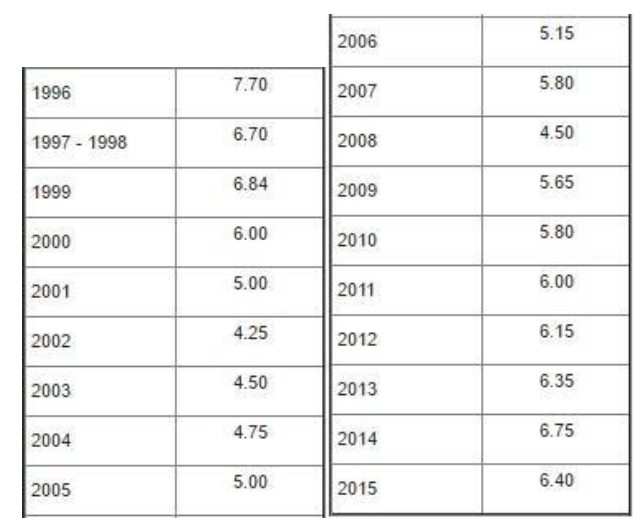
    The Employees Provident Fund (EPF) is one of the most commonly used channel by Malaysians in general as it is deemed compulsory for employees to deposit funds into EPF1, as well as for employers to contribute a portion on behalf of the employees2. The diagram below shows the dividend rates by EPF for the past 20 years:

    screen-shot-2016-11-05-at-9-02-44-pm

    Source: Employees Provident Fund (EPF)

    EPF guarantees an annual base dividend of 2.5% (EPF, 2016), with higher dividends expected if the economy is good in that particular year. For example, there is a steady increase in EPF annual dividend rates from year 2008 – 2014 as the economy was doing well. Besides, it is considered as the one of the safest channels to deposit your funds as it is regulated under the Ministry of Finance. Though, it was reported that 65% of active EPF contributors has less than RM50,000 in their accounts (Bernama, 2016). Perhaps EPF does not provide enough returns with the petty fixed amount of contributions deposited every month, which brings us to private retirement schemes.

    Dividend : Regular payments that are given to you as a percentage of the amount of you and your employer’s’ contribution 

    ¹ 11% of wages/salary regardless of income level.
    ² 12% of wages/salary for employees receiving wages/salary exceeding RM5000 per month, 13% wages/salary for employees receiving wages/salary below RM5000 per month.
    For more information about the EPF, kindly visit the website stated below: http://www.kwsp.gov.my/portal/en/web/kwsp/home

    3.2 Private Retirement Schemes (PRS)

    Other than government-owned funds, there also exist private retirement schemes offered by various banks’ asset management or mutual funds divisions in Malaysia. These divisions are called Private Retirement Scheme Providers, or PRS Providers.1

    The main difference between the EPF and PRS is that PRS offers the flexibility to deposit any amount of money into the scheme every month while EPF deposits a fixed percentage of income into the EPF account. This means that the PRS may potentially offer higher returns if the dividend rates are high and the total funds deposited it large enough. Besides, since the procedures of depositing additional funds into the EPF is tedious,2 people may opt to deposit their funds into PRS to save the hassle.

    Though it should be reminded that PRS funds will be dispersed into 2 subaccounts at a 70-30 ratio. If the individual wishes to withdraw money from the PRS, the individual can only withdraw money from the latter account (30% account) (Chan, 2015). Hence, careful consideration of deposits must be made by the individual as funds are not easily withdrawn.

    ¹ Currently provided by 8 banking groups in Malaysia.
    Full list available at: https://ringgitplus.com/en/blog/Budgeting-Saving/A-Guide-to-the-PrivateRetirementScheme-PRS.html
    ² Requires the individual to fill up a form and apply for it. If there is any changes after that, the individual is required to go through the same procedure again.

    3.3 Individual Savings & Investments

    In addition to above, one can simply save in whichever bank account, or invest in any investments he or she see fit. However, we will discuss inflation, in which interest rates in banks barely keep up with, as well as the lack of investment knowledge that puts this option at a huge caution.

    4.0 Additional Factors to Consider

    Of course, there are many more ways to finance an individual’s retirement, but the 3 listed above are some of the common ways to do it. Other than comparing the characteristics, benefits, and disadvantages of each channel, it is important to consider in some external factors as well.

    4.1 Inflation

    screen-shot-2016-11-05-at-9-03-25-pm

    Rise, rise! Except for the value of your money. 

    Source: The Star Online & CIMB Wealth Advisors

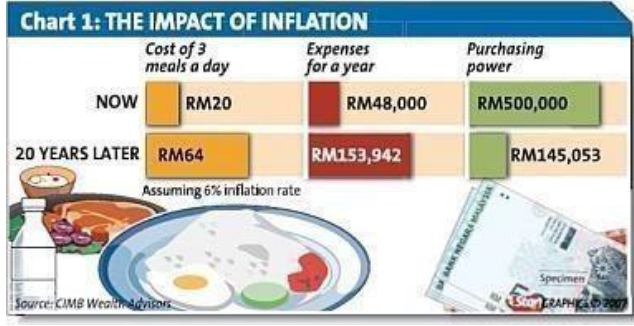
    Inflation, an overall general rise in prices of goods (Brealey, et al., 2001), will affect your retirement planning. Constant increases in expenditure per annum is inevitable, causing a shrink in value of money over time. It is important to remember this quote “a dollar today is worth more than a dollar tomorrow” 3. Hence, the total estimated savings should deduct off inflation, giving a real amount4 of it.

    3 Simple illustration: You can buy a piece of roti canai for RM1 today, but it might cost more in the future. Perhaps it will be RM2? RM3? We don’t know. But it is certain that it will cost more than RM1 as the value of money has shrunk.
    4 Amount of money after deducting inflation.

    4.2 Medical Costs

    screen-shot-2016-11-05-at-9-03-40-pm

    Source: http://www.healthjobsweb.com/images/hospital-medical-tech.jpg

    Trust me, medical bills will be presented to you at a more frequent rate than you will have expected at your older ages. Medical costs are also expected to increase by at least 15% per annum (Habib, 2007). In order to not further financially burden your children with your medical bills, it is advisable to get attached to a health insurance5 as soon as possible. Health insurances prevents a heavy depletion of your retirements funds as it covers part of your major medical costs. For example, health insurance subscribers will be compensated some amount of money if they undergo certain surgeries or treatment for certain diseases.
    5 Examples of health insurance can be found here: https://ringgitplus.com/en/health-insurance/medical-card/

    4.3 Longevity Risk

    Longevity risk is the risk that you live too long (what a drag!) such that your funds will have depleted as time went on . As your lifespan is unknown, this makes saving for your future a lot more uncertain as it becomes a lot more difficult to determine the total amount you’d need at retirement. One particular product that transfers this risk to an insurance company is called an annuity. An annuity promises regular payments to you until you die, subject to various increases in payments depending on the insurance company.

    5.0 Conclusion

    There are limitless personal factors to consider as well. However, the moral of the story is the earlier you plan for your retirement, the larger the funds available for your retirement. This is because you will be able to contribute more to your retirement plan as you are earning income. It was also reported that half of our country’s retirees have depleted their EPF savings within 5 years of withdrawal (Arfudi, 2015), therefore it is advisable to save in multiple channels to meet your financial needs when you are old.


    Download the Report and Infographic Here:

    [download id=”131″]
    [download id=”134″]


    [tw-toggle title=”References “]

    Arfudi, Z., 2015. Malaysian Digest. [Online]Available at: http://www.malaysiandigest.com/features/585044-50retireesexhausted-their-savings-within-five-years-of-retirement-how-canyouavoid-this.html [Accessed 13 September 2016].

    Bernama, 2016. Free Malaysia Today. [Online] Available at: http://www.freemalaysiatoday.com/category/nation/2016/05/15/money-inepf-but-not-enough-for-retirement/ [Accessed 10 September 2016].

    Brealey, R. A., Myers, S. C. & Marcus, A. J., 2001. Fundamentals of Corporate Finance. 3rd ed. s.l.:The Mc-Graw Hill Companies.

    Chan, D., 2015. RinggitPlus. [Online] Available at: https://ringgitplus.com/en/blog/Budgeting-Saving/A-Guidetothe-Private-Retirement-Scheme-PRS.html [Accessed 12 September 2016].

    EPF, 2016. Employees Provident Fund. [Online] Available at: http://www.kwsp.gov.my/portal/about-epf/overview-of-the-epf [Accessed 9 September 2016].

    Habib, S., 2007. The Star Online. [Online] Available at: http://www.thestar.com.my/news/nation/2007/05/27/countingon-the-nestegg/ [Accessed 13 September 2016].

    Insurance, H., 2009. The Future of Retirement, s.l.: HSBC Insurance.

    Investopedia, 2016. [Online] Available at: http://www.investopedia.com/terms/r/retirement.asp [Accessed 8 September 2016].

    Malaysia, D. o. S., 2015. ABRIDGED LIFE TABLES, MALAYSIA, 2012 – 2015, s.l.: Department of Statistics Malaysia.

    [/tw-toggle]


    Prepared by Lee Hou Yin

  • Stocks

    Stocks

    Stocks or shares have been one of the most well-known financial instruments in the finance world. At this point of time, you must have come across the word stocks or shares either from your parents, friends, books or even someone sitting at the table beside yours, discussing about stock market while you are having lunch. So what exactly is a stock? Stocks represents a company’s ownership rights. Owning a stock simply means having a share of the value a company, as you own a chunk of the company. This stock can be bought, sold, or traded as an investment. Still confused? I will now explain what stock is about in a more unconventional way.

    Let’s say you and I are building a pizza company. We each contributed RM1000 to the company and now the company has RM2000 cash as assets. It looks a little too shabby just to start a pizza business with RM2000, isn’t it? We then find 8 more partners each contributing RM1000 to the company. Now, each of us partners own one tenth of the company which translates into number of stocks in the real world. Equipped with the cash, also known as the start-up capital, we bought ingredients, appliances, hire staff, and rent a shop with bicycles for delivery. As the business grows, we’re making handsome profit of RM1200 each year after cost. This means each of us stockholders earned RM120 at the end of each year which explains the first part of the definition where stock means a share of the value of the company. Not too bad for an investment that generates 12% return annually.

    pizza

    Here’s a pizza to show that we are sharing the profits of the company by slices, Bon Appétit!

    [Picture from: www.titospizzaspringhill.com]

    As the business grows, the profits we made might not be sufficient to further expand our business to a larger scale. When this happens, we have options such as to look for private
    investors that have an interest in our business or to scale it up using IPO. Well, the private investor bit is basically repeating what we had done when we looked for 8 more partners to contribute additional capital to the business, but what the on earth is an IPO?

    IPO is an abbreviation that stands for initial public offering. In Malaysia, private companies commonly have the names Sdn Bhd (Sendirian Berhad), while public companies simply have Bhd (Berhad). An initial public offering (IPO) is the first time that the stock of a private company is offered to the public. This is when the public is offered an opportunity to invest in our company by subscribing or buying our company’s stock. The cash proceeds from the public and other investors are then to be reinvested into the company for expansion or other purposes that seemed fit. There is a lot more a company has to do and has to know before an IPO can be carried out but we will skip the technical bit. What happens next? The pizza company that we build got listed in the stock exchange!

    stock-market

    This is a picture of New York Stock Exchange. Our company’s name will appear on the board once we’re listed!

    [Picture from: nyoobserver.files.wordpress.com]

    A stock exchange or stock market is a place where shares of public listed companies are traded. Try imagine a market where people transact in stocks instead of vegetables and fruits. This is the place that the second part of the stock’s definition where a stock can be bought, sold, or traded as an investment are carried out. Any individual or even corporations can buy, sell and trade our company’s share in the stock exchange. There will be a price on our company’s stock that is known as the share price. The share price will serve as a basis on how much our company worth at each point of time and the price is affected by the supply and demand of the stock plus other factors as well. Examples of stock exchanges are such as KLSE, NASDAQ, and NYSE.

    After knowing about stocks and stock market, you must be wondering why all of these are important. An article titled ‘10 financial products to help you plan your retirement’ (Yogi, 2014), pointed out that equity instruments which are stock investments provide returns that can’t be matched by any other financial instruments. Well, the highest return means as an investor, if we can make sound investment decisions, there is a high chance we can grab the opportunity to let our money to work for us harder so that we can enjoy more financial freedom in our life. Who doesn’t want higher returns on their investments?

    stock-market-investing

    Having a high return on your investments does makes you feel better, or at least financially.

    [Picture from: www.stockmarket-investing.com]

    There is much more about the stock market and stocks that a person has to know before even start to trade or invest in stock. Once an individual is equipped with sufficient knowledge and has a right mind set, achieving financial freedom is not a dream but something achievable. So, start your stock investing journey today and you might find something rewarding along the way down the road.


    Download the Report and Infographic Here:

    [download id=”99″]
    [download id=”103″]

    [tw-toggle title=”References “]

    Merriam-Webster (2015) Definition of STOCK. Available at: http://www.merriamwebster.com/dictionary/stock (Accessed: 13 September 2016).

    Investopedia.com (2003) ‘Initial public offering – http://www.investopedia.com/terms/i/ipo.asp (Accessed: 13 September 2016).

    Bennett (2016) Definition of ’stock market’ – the economic times. Available at: http://economictimes.indiatimes.com/definition/stock-market (Accessed: 13 September 2016).

    Yogi, I. (2014) 10 financial products to help you plan your retirement. Available at: http://www.business-standard.com/article/pf/10-financial-products-to-help-you-plan- yourretirement-114041500210_1.html (Accessed: 13 September 2016).

    [/tw-toggle]


    Prepared by Goh Jia Jun

Subscribe to us now!

Interested in achieving financial literacy?