Author: FLY: Malaysia

  • Budgeting Before Examinations

    Budgeting Before Examinations

    Finals are around the corner and you may have already started to feel the immense pressure as you burn the midnight oil, trying to cram all facts and formulas you’ve learnt over the past few months in less than a couple of weeks (or days) time. Have you felt like quitting at any point in time and having a sudden urge to spend all you can to enjoy? Or if you are a quiet person, chances are that you might vent by doing things alone such as stress eating. This is when budgeting comes in handy so you don’t burn a hole in your pocket and resort to fast food and instant noodles for the rest of the month. Budgeting is crucial for this is where you can control your spending or at least observe the changes in your spending patterns during these periods. In most cases, spendings during these periods will leap by multiple folds than the usual average, especially for those who relieve stress through eating, shopping or traveling. On the other extreme, there will be a drastic fall from the average spending for cases like depressive or repressive behaviours when one is stressed.

    Very often, the changes in spending patterns during these intense periods are driven by personal emotions. For instance, a large portion of spendings before an event (finals per say) is driven by stress and anxiety whereby stress eaters tend to splurge on food while some opt for other forms of entertainment to relieve stress. After an event, however, the spending patterns may vary for they are now influenced by emotions such as anger, guilt or remorse and hence, most will be aggressively spending in places such as the karaoke, gaming centre, or even capcom station to vent out these negative emotions. Conversely, those who experienced positive emotions after an event would probably be able return to their normal spending pattern rapidly.

    Spending During Emotional Periods

    When you feel stressed, you tend to overspend because it may help you, although just temporarily. During this emotional period, there is unlikely a specific target on which most people will spend money. However, there are a few targets which are very common.

    Firstly, food and beverages. Some people spend more on eating and drinking, especially snacks, when they feel stressed as compared to their usual days. Emotional eating is recognised as one of the ways to soothe negative emotions. As it distracts one from negativities, it often leads to mindless overeating. What’s worse is that when we are emotionally hungry, we often crave for comfort food like sweets, chocolate, chips and other high caloric foods. This is obviously different from physical hunger which can normally be satisfied with a wide range of foods. One who is actually hungry is likely to stop eating once they feel full. While physical hunger comes on gradually, emotional hunger hits in an instant. It is possible that we feel hungry (emotionally) for 45 minutes to one hour after taking meal. Even though such hunger does not make sense, we tend to fix our cravings and feel good after that.

    Secondly, shopping. Some people feel that they deserve whatever they buy even though they cannot justify the shopping. They will keep convincing themselves that shopping will make them feel better and more motivated to face the reality. They feel satisfied through shopping without realising that this is a trap for them to purchase more and more mostly unnecessary products. This concern has only worsened in today’s world where online shopping has become a global trend across the globe. Due to its convenience, many has the habit of one-click buying. Consequently, when shopping becomes easier, feeling happy becomes easier. This then becomes a dangerous cycle where people would feel stressed ‘more easily’ and always use pressure as a justification for overspending

    The greatest danger of overspending during emotional periods is that there is no bottom line. It then becomes an occasional habit to destress which at the end of the day, might result in financial ruin if not properly controlled.

    How Does Budgeting Take Place?

    Eating three packets of Maggi goreng Tomyam while studying at 3am will not make your smarter and might even cause your stomach to cry for help, which is counter-productive if your exams are on the next day. It goes without saying that budgeting is important for one to manage their personal cash flows smartly and prevent any health issues that may arise from stress eating.

    Therefore, the first step is to control your emotions before purchasing or even before the budgeting process takes place. A study by UCL (2006) has confirmed the hypothesis that irrational decisions is caused by our emotions, while the degree of irrational decisions made varies among different individuals. A person with an independent and sound mind is more likely to make better decisions, but many individuals still choose to ignore the advice and decide based on their “mood”. Therefore, before any decisions or budgets are made, calm yourself down and evaluate the possible benefits and drawbacks of making the spending decision.

    Secondly, of course, is to identify the amount of resources (or money) available for yourself. From this pool of funds, you can flex your budget according to your liking and possibly acquire better quality products. For example, instead of crunching peanuts when you burn the midnight oil, you can purchase the healthier sunflower seeds to act as a substitute. However, quoting an old Chinese proverb “there is no free lunch in this world”. Money does not just fall out of the sky, but rather acquired through proper means and hard work beforehand.

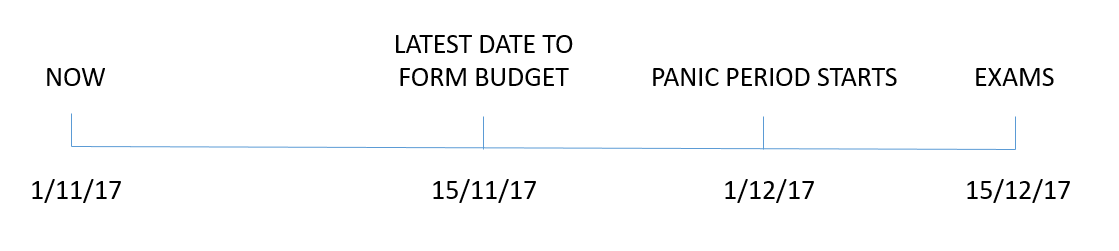
    The third step is to plan your budget earlier. If you have concerns of overspending prior to exams, it is best to have a plan to counter it as early as possible. Consider planning a month prior to the examinations and follow it strictly to prevent any misfortunes to your finances. The timeline below illustrates a simple example of good time management and budgeting for the future:
    Learn to Know Your “Wants” and “Needs”

    One more important tip in budgeting is being aware whether you’re spending is a “want” or a “need”. In the context of budgeting, “wants” are items that you desire to have and will do just fine without, whereas “needs” are items that you definitely need in any and all situations. Some individuals’ budget may consist of more “wants” than “needs”, thus wasting precious resource allocation. Successfully identifying and separating “wants” from “needs” will save you a lot of money, which may turn to more money for post-exam celebrations instead of blowing up everything before the exams. Consider the illustration below on economy rice:
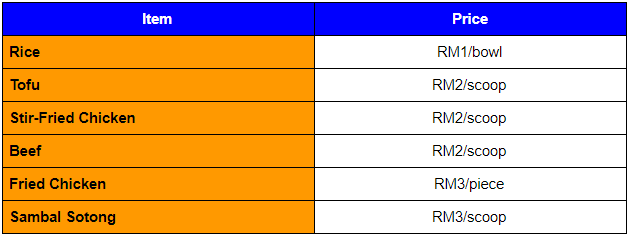
    Michael has a budget of RM5 for his ordinary economy rice meal, consisting of rice, tofu, and a choice of either stir-fried chicken or beef. However, due to pre-exam stress, he has decided to take a piece of additional fried chicken or a scoop of sambal sotong for all his economy rice meals in order to “reduce stress”. This happens in all 10 days before the exam date (2 meals of economy rice per day). Simple maths will tell you that he is over his budget by RM60 in the span of 10 days!
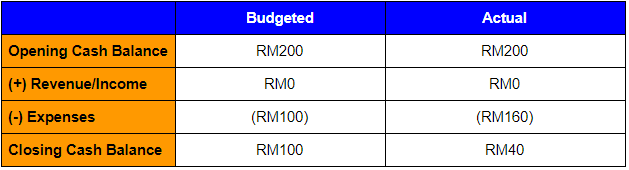
    On the 11th day, final exams have finally ended. Michael’s girlfriend wants him to bring her to a steakhouse for post-exams celebration, costing RM50 for 2 people. However, due to the constant overspending of Michael in the past 10 days, he does not have the cash to bring his girlfriend to the steakhouse.
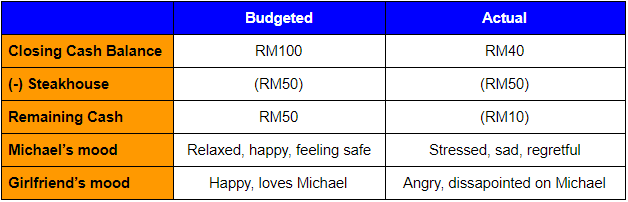
    Due to this, Michael was reprimanded by his girlfriend and now his finances are being fully controlled by his girlfriend as she does not trust Michael with his finances.

    Note that the above illustration is purely fictional and does not resemble any real-life scenarios, but it does convey two messages. One, discipline is virtue to maintaining a good financial position for an individual; two, budget and expenses should be spent on necessary items, and unnecessary items should be kept till your finances allow it to be purchased. Imagine if Michael had not been rampantly spending on his economy rice meals, he will have cash to treat his girlfriend to the steakhouse and still have an extra RM50 in his pocket to spend on his girlfriend, preserving the image of a good boyfriend and avoiding any potential conflicts.

    Pros and Cons For This Form of Budgeting

    While budgeting may sound dull and troublesome to most people, there are many direct and indirect ways it can benefit us. The most straightforward ones would be to enable one to plan and minimise unnecessary spending. As simple as it sounds, this will have a large impact on your spendings and savings. Imagine shopping for a list of goods in a supermarket with and without a budget. If you have a budget in hand, you would have to prioritise those items on the the list that is most needed in your cart, enabling you to adjust yours spendings on less important items. In this case, budgeting helps you reassess what is truly important for you at the moment in time, and thus, enhancing your overall quality of life (Quicken, 2017) . On the other hand, one without such a tool would stand a high chance on spending more in total to obtain the same list of items as one will resort to impulsive buying and thus have more freedom in getting items that are not listed. Also, it is clear that budgeting would aid in reducing financial difficulties in daily lives. When faced with stress from examinations, you would obviously want to avoid additional stress from not having enough money to spend before your next allowance. The most simple form of budgeting such as dividing monthly allowances into weekly or monthly budgets would be good enough for a well-controlled personal finance.

    As good as budgeting may sound, there are also some drawbacks of budgeting. Especially when you are prone to make irrational choices during these periods influenced by extreme emotions, the budget formed may not be one of the best solutions to solve your underlying problems or to even achieve the goal of your budgeting (to relieve stress in a cost-efficient manner).  To make things worse, one may resort to cheat by discontinuing budget planning during these periods to omit their current limits on spendings. While this is not a serious offence in any sense, this action will bridge the initial intention of budgeting, particularly during times when it is most needed to ensure control and balance in one’s personal finance.

    Overcoming Problems / Alternatives to Reduce This Form of Spending?

    It takes time and effort to overcome emotional spending. As discussed, such a habit is normally a result of feeling stressed. Hence, it is of utmost importance for us to first deal with the triggers that cause us to stress out. There can be a wide range of factors including poor sleeping quality, heavy workload, relationship issues etc. All these may result in us feeling tensed. We have to first recognise the factor, then only can we move on to the next step to cure the underlying problem. For example, if we feel stressed due to heavy workload, it is best and helpful to plan a timetable and adhere to it. In fact, all that needs to be considered when planning a timetable is important but not equally urgent matters. Important tasks contribute to long-term goals while urgent tasks are to be completed within a relatively shorter period of time. Hence, always bear in mind to prioritise what is urgent over what is important while planning. Also, try to look for alternatives that can help with de-stressing. It is scientifically proven that exercise and meditation are even more helpful when it comes to dealing with stress and coping with problems. However, it is undoubtable that sometimes, spending is simply one of the coping mechanism for some people. If that is the case, then the spending must be monitored.

    In such situations, it is best to take a step back before going on for another round of shopping and evaluate the spending pattern. List out what you have purchased in the past especially during emotional periods. Looking at the list, people normally realise that most are unnecessary and can be avoided. It is also important to note that the mindset “I deserve this” is no excuse. Neither is “it is just an insignificant amount”, as rewards should not come too often and small amounts add up at the end of the day.

    This step of evaluating one’s spending cycle must be done simultaneously with the previous steps. Such compare and contrast approach will then show that the former is better in dealing with tension; lower cost – less spending, better outcome – refreshing mind and work of better quality. Overspending is rarely the way out as the underlying problems would remain unresolved after all.

    One point to be noted, this journey is not an all dead fight. After some time, when daily spending is reduced from a maximum of RM 50 to only RM 30, the money saved is the motivation to avoid emotional spending which is most of the time unnecessary. In other words, the accomplishment of saving is satisfying. However, once a blue moon, say, when RM 200 is saved, take a rest and treat yourself. Then, go on and save more for the next!

    Conclusion

    Spending on emotions is a typical scenario regardless of gender and this is especially true during intense periods such as examinations. Therefore, budgeting plays a key role in managing one’s life. While it is common that most of us live with a fixed amount of allowance from our parents every month, budgeting becomes an essential lesson to us in hope that our pressure during these periods would be lessened or at least excludes financial pressure. As most things come in good and bad, so does budgeting. Hence, the extent to which budgeting can benefit one really depends on how wise and rational a person is in planning and the commitment and determination in continuing the cycle.

    [tw-toggle title=”References:”]
    Quicken (2017), ‘How Can Budgeting Affect One’s Personal Life?’ [online] Available at: https://www.quicken.com/how-can-budgeting-affect-ones-personal-life Accessed 30 October 2017

    UCL (2006), ‘Irrational decisions driven by emotions’ [online] Available at: https://www.ucl.ac.uk/media/library/decisionbrain Accessed 27 October 2017

    [/tw-toggle]

    Download article here : [download id=”2630″]

    Contributors:

    Researchers – Lee Hou Yin, Wong Vyleen, Max Kong Chee Yoong
    Editor – Lim Shu Ni


  • Guide 101: Budgeting for a Trip

    Guide 101: Budgeting for a Trip

    Every country announces a budget plan annually. This shows that budget planning plays an important role to maintain financial soundness. If a country puts effort in planning for a budget, individuals should have a budget plan for everything involving monetary terms. By doing so, they can keep track of the inflow and outflow of money. To contextualize the idea of budgeting, it is more practical to exemplify it with a case study of budget planning for a trip.

    Case Study:

    Eddy is dying to go on a short trip to Boracay Island for a short getaway and in the meantime, to find peace within himself.

    Problem

    You see, Eddy is a typical college student. By typical, it means that he is technically broke. To be precise, he has yet to earn a stable income other than receiving monthly allowance from his parents. Apart from that, he works as a part-timer in a retail outlet which does not fulfill his desire for shopping. Hence, he feels that he does not have enough money to do whatever he wants.

    Figuring out how much Eddy needs:

    The key to any trip is being smart with your money and that starts even before you hit the road. It is important to know how to save and plan your trip so you don’t find yourself running out of money along the way.

    The tip here is to start allocating your budget with the major expenses first – usually this will be the cost of your flight tickets, but accommodation also adds up too! We should not forget the minor expenses needed to taste local delicacies of the foreign land as well. It is wise if we can even get sample prices as a rough idea of how much it costs for a room, a street snack or a restaurant meal!

    For this case, a quick search on google showed that Eddy needs roughly RM1200 for his short getaway.

    CAN EDDY AFFORD THE TRIP?

    The financial affordability of Eddy for this trip comes into question. If Eddy has extra savings kept aside, he might be able to fund his travel expenses. Or else, he might need to figure out other ways to acquire the amount of money needed. The next question comes into picture now. By how much is Eddy short of for this trip? To identify this problem, he needs to look into his monthly expenditure, monthly allowance and savings account. It will be much simpler for Eddy to tabulate it and find out with a monthly budget. Let us look into Eddy’s financial condition with the following steps.

    STEP 1: Get yourself a big piece of paper

    And obviously a pen.

    STEP 2: List down all your monthly income

    The first step to taking control of your finances is by planning out your budget. It will take some effort, but it is a great way to get a quick snapshot of the money you have coming in and going out.

    Eddy starts by adding up his monthly income:

    According to this information, Eddy has RM 2,400 to spend every month.

    A good tip right here is that you always guess (estimate) low for income, and guess (estimate) high for expenses. This prevents you from overstating your income and understating your expenses. In general, this approach is prudent as it gives you extra capacity to manage your funds on hand.

    STEP 3: Identifying Outflow

    This part is a little tricky. The best way someone can accurately measure this is to look back at his or her spending history.

    Red flag is up. Eddy is making a loss every month. In other words, he has zero disposable income and zero savings. How is he going to fund his trip? How is he going to save then? What are the alternatives?

    STEP 4: Identifying needs and wants

    Eddy needs to classify his expenditure into two major classes. They will be (1) necessary expenditure and (2) optional expenditure. In layman’s terms, the things Eddy spent on could be categorized into his “needs” and his “wants”. To do that, let us take a look at his monthly expenses.

    STEP 5: Planning a Budget

    Generally, personal financial constraints refers to the lack of funds to purchase things a person desires. In other words, Eddy is facing personal financial constraints by not having enough budget for this trip. However, there are a few alternatives which Eddy can consider to save up $1200 for this trip.

    Plan A: Saving $110 per month

    Referring to the table computed above, Eddy can opt to cut down on the unnecessary expenses, including shopping and sundry expenses. The idea of this part is if it’s a “want”, we will cut the expenses by 50%. On top of it, Eddy could save up quite a bit if he were to switch to a cheaper monthly gym membership plan and monthly telephone plan. Let us assume Eddy had managed to scout around and found a store that offers lower price rates for his sundries. He then walks to the sundry store to purchase what he needs. Just by doing that, he is able to cut down RM 130 worth of expenses as well as break into a sweat by walking. As the saying goes, Eddy could kill two birds with one stone.

    Do the math now. Hit the buttons on the calculator! (RM 1200 / RM 110 per month)

    It will take Eddy approximately 11 months to save up to RM 1200 for the trip.

    This means Eddy gets to plan this trip 11 months in advance.

    Plan B: Cheaper meals and cut all want(s)

    Instead of having to wait for a period of 11 months, are there any ways to save RM 1200 faster? Eddy is a gym freak who is not willing to give up on the gym plan he had signed up for. Plus, he does not find the need to switch his phone plan. However, Eddy is willing to cut down his expenses on non-necessities and opt for cheaper meals.

    Since Eddy is a fitness enthusiast, he needs to consume a large amount of carbohydrate and protein in his meals to rebuild his muscles. To kickstart his day, he can prepare bread slices with peanut butter spread. As for lunch, he can enjoy a plate of chicken rice with friends at the budget of RM6. Speaking of dinner options, the local delicacy Ramly Burger which can make a run with the conventional fast food chain burgers at a cheaper selling price can be an affordable yet filling meal. Eddy could also enjoy an egg cracked on or wrapped around his burger patty for dinner.

    Here is the breakdown for every meal in a month:

    With this budget planning, the total estimated monthly expense has gone down by RM 710 as compared to the initial estimation. With this method, Eddy can save up RM 1200 in less than 2 months. This plan could also save up to nearly 80% of Eddy’s time as compared to plan A.

    Plan C: Alternative by borrowing from parents **

    Meanwhile, Eddy thinks of getting funded by his parents. This might be the fastest way to go for a trip. Is that so? Thinking of which, perhaps he need not cut down on his daily expenses for this instance. If his parents lend RM 1200 to him, Eddy is willing to pay back RM 100 per month after his trip. However, we need to take note of initial living expenses. It has exceeded the amount of money he has on hand. How is he going to pay back his owings to his parents of RM 100 per month? In other words, he needs to reduce some of his unnecessary expenditure after the trip to fork out RM 100 per month. At the end of the day, Eddy still needs to fork out RM 100 per month until he completely repays his debts.

    To pay down this ‘loan’, let us first calculate the net present value by using the simple present value of annuity formula.

    Assuming the monthly growth rate equals to 1.3% ; 12 months of payments ; RM 100 per payment, Eddy needs to pay a total net present value of RM 1100. Theoretically, Eddy has an extra RM 100 to spend, whereas his parents are making a loss of approximately RM 100. This could be explained through the fundamental financial theory, Time Value of Money. The current value of money is worth more than the future. Since Eddy agrees to pay back RM100 monthly, Eddy does not need to take into account interest rate or any other relevant factors. In simple terms, Eddy does not need to pay for any extra costs (interest expense) on top of his initial amount of borrowing. Therefore, the amount of RM 1200 is worth more for this instance as compared to the total amount of repayment for Eddy in the future given the discount rate of 1.3% monthly.

    Isn’t it reasonable and rational for Eddy to borrow some cash from his parents? In comparison to all three suggested alternatives, this method seems to be the most cost-effective and the most efficient choice of funding for the trip. It requires nearly zero cost and has the least time consumption to reach the RM 1200 target of budget for the trip. However, we need to take into account the saving pattern Eddy should have. It is always good to save for rainy days.

    Comparison for 3 plans

    Among the three plans suggested above, Eddy has to weigh the costs and benefits of each one of them. Every plan presents different values of money. Plan A and Plan C are considered to be very different from Plan B. From the detailed budget planning in Plan B, it is evident that Eddy has to make slight drastic changes in his budgeting plan to save up RM 1200 effectively in 2 months. This will require Eddy to cut down a lot on his spendings for sundries and on shopping. Let us not forget, Eddy would need to have an affordable meal such as Ramly Burger for dinner daily as well as prepare his own breakfast every morning. If Eddy is determined to stand on his own feet, this plan is moderately and reasonably sound. Or else, he might need to consider the two other plans which seem to be easier to carry out.

    For Plan A, Eddy gets to save up to RM 1200 in 11 months by contributing RM110 per month into his budget. However in this plan, it was not taken into account the risks involved such as inflation, interest rate and foreign exchange risk. On the other hand, these risks have a smaller impact on Plan C. Upon implementation of Plan C, Eddy might need to forgo part of the opportunity cost by reducing certain optional expenditures in his monthly financial budget after his trip. As agreed, he is obliged to pay back his parents RM 100 per month. Coming into the subject of potential earnings, the time value of money seems to be higher in Plan C. Eddy needs to pay back an amount totalling RM1100 of the present value of the future cash flow. In other words, when we discount a monthly amount of RM100 as fixed payment to the current period, Eddy makes a profit of RM 100 each month.

    In comparing these two similar plans (Plan A and Plan C), Eddy does not need to make that much changes or adjustments with his monthly expenditure. However, he needs to take into consideration the opportunity cost he is willing to forgo now or in the future. Somehow, every choice made comes with its own consequences. Nevertheless, Eddy gets to understand the ‘price’ he needs to pay for every decision made.

    Budgeting techniques and risks for overseas spending

    Now that Eddy has carried out an analysis of the budgeting plans available for himself, it is now time to plan and prepare for the future by finding out the right budgeting techniques and risks during the trip.

    It is near impossible to escape from F.E.A.R (Foreign Exchange Associated Risk) in the process of budgeting for overseas spending, even for Eddy himself. The underlying concept of risk arises from the possibilities of a loss in value from an unfavourable exchange rate fluctuation at the time of conversion of your home currency to another currency. For overseas investors, various financial models or trading strategies have been adopted in dealing with unavoidable risks associated with foreign investments. The most conventional method for investors in dealing with such risks is by carrying out hedging via forward contracts, future contracts and so on. However, coming back to our main discussion on this article, budgeting for an overseas trip by any means should not require Eddy to adopt such complex and complicated models. As it would be illogical for Eddy to carry out the trading strategies mentioned previously for an overseas trip spending budgeting plan, many other factors should be considered to minimize the risks associated with currency conversion and overseas transaction while travelling.

    The first factor may be a common concept which tends to be overlooked or neglected by overseas spenders – methods of currency conversion or withdrawal. The interest rate charges or service charges imposed by financial institutions may not be a matter of concern for infrequent currency conversion or withdrawal, but the compounding effect or accumulation of such charges will be a shocking amount at the end of the day for a person unaware of the frequency of their withdrawals or conversion. As a general rule for currency conversion, using ATM machines supporting PLUS platform that charges a range of fixed amount for every foreign withdrawal (eg. Maybank charges RM 12 per foreign withdrawal) is the best and most reliable choice for currency conversion.

    In addition, another common currency conversion method that is widely practiced in all countries is money exchange via the foreign exchange office, or commonly known as the money changers. Among the things that Eddy has to take note of when deciding to convert currency at money changers include the location of exchange offices, rates offered, and service charges imposed. Location at which these money changers are situated offers different rates or service fees for currency conversion, and money changers at airports and grand hotels tend to offer higher charges and lower rates compared to any other local money changers elsewhere. Moreover, certain money changers also tend to impose hidden or additional charges and it is important to enquire on these charges before using their services. Eddy should keep himself aware from time-to-time regarding the latest foreign exchange rates, by utilizing apps such as the XE Currency Converter app to ensure he gets the best deals from the right money conversion source.

    With growing advancements in the market and financial field, various payment methods are made available to spenders internationally either via conventional methods (eg. debit card, credit card, cash etc), or via mobile and online payment methods (eg. Alipay or Zhifubao). However, this section will be focused on the conventional methods as opposed to the mobile and online payment methods which are yet to be widely practiced globally. It is always advisable to avoid debit card payments and to carry out transactions overseas by credit card or direct cash payments. It is undeniable that spenders utilizing card payments will tend to face higher possibilities of error in transaction which may cause them to be overcharged compared to cash payment users. Transactions carried out via debit card payments causes your home bank account to be directly debited (reduction in bank balance), while credit payment will only impose the spending charges on the user at the end of the month. The direct debit nature of debit card payments causes the reversion of such transactions to be more inconvenient to deal with, for which there is an error in the transaction. In normal cases, the debit card user would have to directly inform the home bank on such error within a period of one week for the transaction to be reverted. Telecommunication charges for overseas calls incurred may be costly, but there will be a small portion of the transaction fees involved if the error had gone unnoticed during the trip.

    Lastly, setting a backup or emergency plan for a budgeting plan is always necessary for the unforeseen circumstances that might occur during the period of the overseas trip. Among the common events that Eddy may face include overspending, loss of cash due to theft and so on. Eddy should always have at least 2 bank cards usable internationally through ATM or have a foreign bank account set up for online money/fund transfer. The purpose of having multiple bank accounts is to create an emergency/backup fund on one of the bank accounts, which will ONLY be withdrawn on certain situations and not for casual daily spending. With all the features and functions of cards being mentioned previously, Eddy should also never forget to:

    (i) Activate his bank cards or accounts for international usage (eg. Enabling Maybank overseas option)

    (ii) Contact home bank in advance prior to traveling abroad to prevent bank cards being blocked or having service interruption due to the suspicion of fraud.


    Contributors:
    Researchers – Eddy Do, Wong Zi Heng, Koh Su Yen
    Editors – Nur Iman Tan bt Muhamad Daniel Tan


    Download the article here:

    [download id=”2566″]

  • Budgeting: Staying High During the Lows

    Budgeting: Staying High During the Lows

    Introduction

    For the 99 percent, lacking disposable income for desired goods has become the thorn in our side that we have learned to live with. The conflict between a never-ending demand for things and our limited purchasing power adds on to the thousands of frustrations that is part and parcel of living in this hectic and sophisticated society. A sustainable solution is to impose a budget onto oneself, making sure that the inflow and outflow of cash is supervised in rational accordance to our daily needs and wants. The importance of being money-savvy is further amplified with the arrival of an economic recession.

    An economic recession can be defined as a period of time (at least six months to a few years) in which a country’s overall economy plunges into a significant decline (Investopedia, 2003). Symptoms include drops in the stock market, a hike in unemployment rates followed by a decrease in wages, slumping housing markets, and such other gloomy omens that make even the most astute of bankers cringe when they open their morning papers (Study.com, n.d). These harbingers of economic gloom are all caused by a fall in the country’s Gross Domestic Product (Investopedia, 2003). In short, people in that particular country have notably less disposable income and thus purchasing power: the populace will have less cash on hand to spend on necessities, services, assets, luxury goods, and investments. Based on statistics, the Malaysian median monthly income during the 2008 financial crisis was RM4,025 while the inflation rate reached above 8%. Despite there was a 9.2% increment of median monthly income compared to 2007, households could not enjoy the extra disposable income as it was offset by the high inflation. The extent of a recession’s impact on the average citizen’s lifestyle can be hard to measure, despite its tangible effects. Having budgeting skills and systems in place during hard times will not only come in handy– it could save your life.

    Budgeting strategies differ for people with different demographic backgrounds. Here we break down the effects of a recession on the 3 most vulnerable groups — and talk tips for weathering the storm.

    Students

    In Malaysia, the estimated cost of studies and living for a Bachelor’s Degree in a private institute ranges between RM 75,000 to 93,000 (Mustafa, 2017). It is not uncommon for a student to discontinue their course of study during a recession, to lighten the financial burden on their parents. Those that do not drop out face the twofold blow of having their academic achievements affected by a tighter lifestyle and significant uncertainty in landing future employment. In the US, The Chronicle of Higher Education (2012) revealed that more than a third of seniors and more than a quarter of freshmen did not purchase required academic materials due to its high costs, which affects their learning experience. It also unsurprising that some students need to work extra hours just to get their hands on additional money — resulting in less time devoted to academic pursuits.

    Most students of our generation have faced the almighty fear of post-degree unemployment from the long years of recession at the time we come of age. The anxiety boogeyman runs rampant, doggedly reminding youths of the very real possibility that their hard-earned degree could be obsolete before it even gets to be put to use. With less pocket money for treats like movie tickets, hearty meals, fitness and other motivators, the drain on a student’s mental well-being could enforce patterns of demoralisation that are tough to bust.

    As students are usually working part-time or unemployed, the reasonable course of action is to rationalise their spending with a recession-proof budget. The chart below shows a simple yet effective guide to making your own:

    For a clearer understanding, please refer to: https://www.mindmeister.com/preview/980060486/student-s-guide-to-budgeting-federal-studentaid-2017

    Students can opt for ways to temporarily reduce their parents’ expenditure with help from the colloquial “gah-ment”. A tried and true method is to apply for the National Higher Education Fund (PTPTN loan). The fund was set up with the aim to provide education loans for students pursuing their studies at local higher education institutions, be it public or private. Students can apply online through their official website — but be wary of its registration times (better set that alarm!). Information in regards to its availability for registration, procedures, loan amounts, bank account and repayment methods can be obtained from your respective university’s registry department or the PTPTN official website. By the time graduation comes around, the recession could have ended and with only a 1% flat rate interest per annum, a student can settle their debt quickly and be back on their feet in no time (PTPTN, 2016).

    Students as early as primary or secondary school level can also open a SSPN-i or SSPN-i Plus account under the National Education Savings Scheme. These are affordable saving schemes that offer competitive dividends and comprehensive takaful protection (Mustafa, 2017). With it, students take a proactive role in securing funds for their future degree.

    Should a student find themselves in the mood for unicorn hunting, there are a rainbow of scholarships offered by their educational institutes, and by external sources (Maybank, The Star Education Fund, Petronas Scholarship, Yayasan Khazanah). Note that some scholarships offered by companies consists of bonds in the contract, where the scholarship recipient can secure work with the company once they have graduated — like following a leprechaun and landing in its pot of gold. In between that and mermaid spotting on the scale of achievability, getting enlisted in the Dean’s List (or its equivalent) usually entails a fee discount and other perks.

    Working adults

    Singles in an economic slump can end their lamenting — it is much easier to shoulder monetary concerns for one than it is for marrieds and families.

    During a downturn, the slacking economy will always contribute to a higher unemployment rate: as a measure to maintain the profit margin, employers tend to lay-off their employees to reduce operational costs (Tejvan Pettinger, 2012). Employees are the victims as they have less bargaining power in securing their careers — hence the general mood of dread whenever hard times call.

    For those who survive the first wave of layoffs, a wage reduction comes around to tighten everyone’s belts. Accompanied by a rising cost of living, slashed wages will further reduce employee’s purchasing power and increase the burden of bearing the cost of daily living. Those who fall under the lower income bracket are the most susceptible to this threat, as they usually do not have a large amount of savings to fall back on.

    Sadly, when members of society have little options left (as is the case during a slump), the rate of social crimes like drug dealing, robbery and fraud increases. In a society driven by desperation, trust erodes — and without this vital societal glue, families and communities fall apart at the seams.

    A recession is not the time to turn your nose up at menial jobs. A working adult can double as a GrabCar/Uber driver or a babysitter after their 9-5s to earn extra money (John Uzie, 2016). The main concept of seeking alternative income is to lighten the financial burden of an individual or a family in times of need.

    With limited income, every working adult should plan their finances effectively and efficiently. A proper planning of expenses is required to avoid unnecessary splurging. One financial tenet that all working adults can live by is the 70/20/10 rule (John Paul Quiambao, 2015): of all the income available, 70% should be spent on living expenses while 20% should be kept for savings. The remaining 10% can be used for investments or for paying off current debts. This rule is crucial in financial planning — having extra income would not matter at all if the individual leads an extravagant lifestyle.

    Debts are another major burden for working adults. Paying back car loans and housing mortgages can be extremely taxing as working adults need to constantly settle debts despite facing constraints. When extra savings are available, it is advisable to fork out a portion to pay back what is owed. Overpaying is better than under — anything that expedites the repayment period will pave the way for more financial freedom.

    As the going gets tough, the tough gets going. The key to really surviving a depression is having mettle, grit, and a fighting spirit. In fact, the generation that grew up during the Great Depression in 1930’s America became known as “The Greatest Generation” — having lived through hardship and all the lessons it dealt, they used their post-war prosperity to achieve great ambitions.

    Senior Citizen

    Retired or soon-to-retire citizens are the most vulnerable of the 3 groups as they have the least bargaining power in maintaining their income, regardless of being blue or white collar. With lower efficiency and lack of tech literacy, senior employees are more often than not forced into early retirement as a means to reduce overhead costs in companies. As a result, they are usually left with pension funds and personal savings to see them into their old age.

    Retired citizens who have invested some retirement funds into portfolios will have to make do with lower returns, as the market enters a bearish period (Mike Patton, 2012). As many retirees usually look to investing as a small means of income, having one route cut off becomes yet another hindrance in their golden years.

    During a recession, the level of debt for this group increases, especially when they are forced to leave the workforce earlier. Many must still bear the burden of supporting their offspring’s education and repaying mortgages. Expensive healthcare services become another major issue for the elderly as they no longer have the privilege to pay for them. Overall, the quality of life for retirees declines sharply.

    There is no way to predict if you will retire during a period of prosperity or scarcity. To guarantee a stress-free retirement, look telescopically at the future: early budgeting and planning of personal finance is crucial. While working, investing a portion of income into an investment portfolio is one way to accumulate wealth for retirement. However, investing in the financial market can be more risky if one is not financially literate. To invest in a smarter and safer way, one can consider investing in a unit trust, indices or bonds which have lower risk as compared to stocks. The ultimate goal in investment is to ensure that there are sufficient funds for retirement rather than as a money making tool.

    Retirees can practise Dollar Cost Averaging (DCA) when investing. The idea is to inject a fixed investment fund over a period of time, and not pushing all the money on hand at once into a portfolio. DCA deals with short to medium term market volatility. In simple terms, investments will be less risky with the DCA method because it offsets the effect of price fluctuation (NerdWallet, 2014). However, this method is not a universal technique and depends on the level of risk an individual is comfortable with. (Extra reading can be found here, “A Dollar Cost Averaging Tale”)

    Life insurance is another alternative way to cushion the transition into retirement. It serves as protection for individuals and their family (Tim Maurer, 2016). The coverage of life insurance varies among all providers, but it usually includes covering the education expenses of offspring, paying housing mortgage and providing healthcare services. The earlier you invest in life investment, the more benefits you will enjoy over the course of your life.

    Conclusion

    Life’s track goes up and down. You could need a parachute one day, and a trampoline the next. It is always better to plot your course wisely before bad days set in. In a recession, everyone in society becomes survivors; each stakeholder can overcome the headwinds and outlive the gruelling days if a backup plan is ready to be put into play. How will you tough out the lows and keep your head held high?

    Download The Report Here:

    [download id=”2518″]


    [tw-toggle title=”References:”]

    Tejvan Pettinger, 2012, Negative Impact of Economic Recession.
    https://www.economicshelp.org/blog/5618/economics/negative-impact-of-economic-recession/

    John Uzie, 2016, Effects of Economic Recession & Ways You Can Help Yourself. http://www.olufamous.com/2016/05/effects-of-economic-recession-ways-you.html

    John Paul Quiambao, 2015, The 70-20-10 Rule of Budgeting. http://skydivetosuccess.com/2015/10/the-70-20-10-rule-of-budgeting/

    Mike Patton, 2012, The Stock Market And Recessions, Forbes. https://www.forbes.com/sites/mikepatton/2012/08/24/the-stock-market-and-recessions/#611c6d5252e0

    NerdWallet, 2014, Why Dollar Cost Averaging Is A Smart Investment Strategy, Nasdaq. http://www.nasdaq.com/article/why-dollar-cost-averaging-is-a-smart-investment-strategy-cm354240

    Tim Maurer, 2016, 10 Things You Absolutely Need To Know About Life Insurance, Forbes.  https://www.forbes.com/sites/timmaurer/2016/01/05/10-things-you-absolutely-need-to-know-about-life-insurance/#eaf2d86560ca

    Bank of America (2016). Building an emergency fundAvailable at: https://bettermoneyhabits.bankofamerica.com/en/saving-budgeting/create-safety-net-unexpected-events  

    Bradshaw, L. (2011). Essay on Effects of Recession on Students. [online] CustomWritings.com. Available at: https://www.customwritings.com/blog/example-essays/essay-effects-recession-students.html

    Camuso, A. (n.d.). Budgeting Basics, A Companion Guide to Keeping It Real: How to Get the Support You Need for the Life You Want. [ebook] New Brunswick, New Jersey, p.11. Available at: http://rwjms.rutgers.edu/boggscenter/projects/documents/BudgetModule-1.pdf

    FederalStudentAid. (2017). Not sure where to start in creating and managing your own budget?. [online] Available at: https://studentaid.ed.gov/sa/prepare-for-college/budgeting/creating-your-budget

    Investopedia. (2003). Recession. [online] Available at: http://www.investopedia.com/terms/r/recession.asp

    Mustafa, Z. (2017). How much would it cost to pursue higher education in Malaysia?. NewStraitsTimes. [online] Available at: https://www.nst.com.my/news/2017/03/223461/how-much-would-it-cost-pursue-higher-education-malaysia

    Perbadanan Tabung Pendidikan Tinggi Nasional. (2016). Pertukaran Ujrah. [online] Available at: https://www.ptptn.gov.my/web/guest/pertukaran-ujrah

    Sander, L. (2012). Economy Affects Students’ Academic Performance as Well as Spending Decisions. [online] The Chronicle of Higher Education. Available at: http://www.chronicle.com/article/Economy-Affects-Students/135790

    Smith, J. (2017). 14 Best Budget Apps for 2017. [online] GottaBeMobile. Available at: https://www.gottabemobile.com/best-budget-apps/?gbmsl=1

    Study.com. (n.d.). What is Economic Recession? – Definition, Causes & Effects – Video & Lesson Transcript | Study.com. [online] Available at: http://study.com/academy/lesson/what-is-economic-recession-definition-causes-effects.html

    [/tw-toggle]


    Contributors:

    Researchers– Chong Ker Sun & Tang Wei Jet

    Editor– Lee Bao Jin

  • Malaysia’s Biggest Economic Challenge

    Malaysia’s Biggest Economic Challenge

    Introduction

    Aspiring to become a high income nation by the year 2020, Malaysia is soon to show its results to the world. With per capita income of US$9,850 in 2016 (Kok, 2017), Malaysia is moving towards the high income threshold of US$12,236 as set by the World Bank. Despite the rapid economic expansion during the turn of the century, Malaysia currently face certain challenges that might hinder its growth in the near future.

    Greatest Economic Threat that Malaysia Faces

    In my opinion, the greatest economic threat that Malaysia is facing right now is the middle-income trap. The trap is described as the phenomenon whereby rapidly growing countries experience stagnant income levels, unable to advance to high-income from its current middle-income (Aiyar et. al., 2013). Countries in the middle-income trap often find it hard to break-away. An article by The Economist (2012) reported that only 13 countries in history has escaped the middle-income trap, and Malaysia is absent from the list. Despite local economists arguing that Malaysia has broke free of the middle-income trap (FMT, 2017), its effects are still felt till today and there is always a chance of falling back into the trap.

    Contributing Factors of Countries Falling in the Middle-Income Trap

    One of the factors causing the middle-income trap is the loss of comparative advantage in manufacturing costs paired with the inability to keep up with more developed markets. Malaysia is currently facing a situation where it is incapable of competing with the low prices of neighboring countries such as Myanmar, Cambodia, and Laos and at the same time, Malaysia does not have the technology to compete in the high-quality goods market. It is a lose-lose situation.

    Besides, rising prices further entrench Malaysia’s position in the middle-income trap. The implementation of the GST has reduced the spending power of citizens due to higher commodity prices. Moreover, the housing sector plays a part in this too. Real estate prices have skyrocketed and word on the streets is that the market is in a bubble, though this has been denied by several industry experts (New Straits Times, 2017). The exorbitant prices denies ordinary citizens of the opportunity to own a property as the monthly installments take up a huge portion of their monthly income. With rents increasing and shelter being a basic necessity, this expense is inevitable and will definitely decrease disposal income and subsequently consumption levels.

    Moreover, the plummet of the Ringgit, caused by a combination of factors such as the 1MDB scandal and the oil glut has worsen the whole situation. With the weak Ringgit, all imported raw materials and consumer goods experienced cost push inflation, increasing the burden of both consumers and manufacturers. As investors lose their confidence, the domestic economy is experiencing an outflow of capital which might further deteriorate the floating exchange rate. Hence, the local firms who are doing import trading are heavily impacted as their costs are increasing drastically.

    Impact Towards The Economy

    The middle-income trap has negatively impacted Malaysian households and the economy as a whole. Viewing it from the consumption perspective, low private consumption is expected to occur in the short-term. Although consumer spending remains at a healthy level, it has not reach its full potential due to cautious consumer spending. Due to the rising cost of living and weakening consumer sentiment, households have decreased their spending in order to maintain the same saving level. In term of housing ownership, due to the rising property price, households have begun to save more for a larger property downpayment, especially since the mortgage approval rate has declined in recent years. As a result, a leakage from the market’s circular flow is expected, which will be a further headwind for Malaysia to achieve its high income nation goal.

    Furthermore, investment levels will be affected as well. Lower disposable income potentially leads to lower consumption from the public, which subsequently diminishes the intention of investors to invest in the country. Businesses, for example, will either establish themselves in other countries with better growth prospects or close down due to their inability to make profits. There are signs of lower investment happening already as shown by the Global Competitive Index. The index shows the competitive levels of the countries based on their productivity drivers. Malaysia was ranked 18th in year 2015/2016 but has slid to 25th in the following year (WEC, 2017). Domestic investments are reported to be down by 5% as well (Tan, 2017) and the introduction of the GST has made matters worse. Potential business owners are hesitant to borrow money for investing into a business as the costs needed to sustain a business have increased. Hefty administrative and compliance costs are also expected for a newly-formed business due to GST. With uncertainty in the demand of goods and services and a more cautious spending pattern, it is little surprise that investors opt to hold back and invest in more promising markets. The lack of investments will negatively impact the country’s economic prospects and will definitely deter hopes of breaking through the middle-income trap.

    In the social context, it is highly likely that the middle-income trap will lead to an outflow of skilled human capital. The brain drain issue has worsened over the past decade and there are no signs of decline (Nadaraj, 2016). Apart from political and social issues contributing to this phenomena, stagnant real growth in wages played a big part as well. Statistics show that median wages have increased steadily in recent years. However, it is cancelled off, and in some years, overtaken by the inflation rate. Hence, the net effect is that there has been no changes in real wages and disposal income for an individual. Younger professionals might seek better employment options overseas and eventually migrate to that country as they perceive that said country can provide a better social and economical environment for themselves and their future family. This is evident in the Malaysian context whereby young Malaysians are hoping to enrol into the best universities outside Malaysia and build their career in the said country.

    Possible Solutions to Tackle and Breakthrough the Trap

    To overcome the middle-income trap, several measure should be taken in order to boost business activity in Malaysia. Data shows that 65% of total employment in Malaysia are provided by small and medium enterprises (SME) (World Bank, 2016). These SME contributed nearly 36% of Malaysian GDP. It can be said that SMEs are  the backbone of the local economy. However, SMEs nowadays are facing financial constraints in the form of tightening loan approvals from banks and fluctuating commodity prices. For those SMEs who import raw materials from other countries, they further face the disadvantage of a weak exchange rate. Therefore, grants and credit should be provided for SMEs to encourage R&D in order to improve productivity or to reduce the cost of production, which will ultimately help the SME’s sustainability in the long-run. The Ministry of International Trade and Industry should also play a role in helping SMEs promote their products in the global marketplace in order to boost their revenues and expand their businesses.

    As mentioned above, investments have shifted to neighbouring countries due to their lower cost of production. Governments should work to keep these investments within the country and attract more investments into the country by providing more beneficial conditions to all investor, such as better infrastructure, a more productive workforce, and tax reductions or exemption for the first few years. The initiative in making Malaysia a favourable place for businesses and investment is crucial for the future growth of the country and the improvement in households’ income.

    In order to tackle the rising cost of living, the government plays a pivotal role in monitoring the price setting of products in the country. Regardless of cost-push inflation, the government should implement a certain level of protection to cushion the impact of rising cost towards households. Initiative like setting ceiling price on necessities, increasing the minimum wage, and giving out subsidies to vulnerable groups can be implemented to counter the inflation in the short-term period. However, continuous subsidies from government will not be a viable option in the long-run as this will worsen the country’s budget deficit  might potentially set Malaysia into another financial crisis. Therefore, households should also reduce their dependance on the government and seek for alternatives in tackling this issue. Besides ordinary income, households can seek side income by investing a portion of their savings into investment vehicles. Despite the volatility of the financial market, households can choose to invest in some lower risk investment vehicle such as bonds compared to the risky stock market. Good financial planning will not only help households survive during the lows, but also thrive during the boom.

    Conclusion

    In conclusion, despite the positive projection of Malaysia’s GDP growth, the economy as a whole has not fully benefitted from it as the growth is offset by the impact of inflation and a weak Ringgit. To escape from the middle-income trap, the focus should remain on empowering national growth but at the same time focus on solutions to mitigate contributing factors of the middle-income trap. Governments should not be the sole authority that works toward this goal, but collaborations should occur with the private sector as well due to the ability to contribute a fair share towards achieving the high-income status. These collaborations ensure different perspectives are being considered and the best possible solution that benefit all sectors can be made to march towards the common goal, a nation that prospers with high-income earning citizens by the year 2020.

    Download the Report Here:

    [download id=”2490″]

    [tw-toggle title=”References”]

    Aiyar, S., Duval, R., Puy, D., Wu, Y., Zhang L. (2013) “Growth Slowdowns and the Middle-Income Trap” Available at: https://www.imf.org/en/Publications/WP/Issues/2016/12/31/Growth-Slowdowns-and-the-Middle-Income-Trap-40411

    FMT (2017), “Pemandu: NTP helped Malaysia escape middle-income trap” Available at: http://www.freemalaysiatoday.com/category/nation/2017/05/23/pemandu-ntp-helped-malaysia-escape-middle-income-trap/

    Kim, C. (2017)  “Malaysia making right progress towards high-income nation, says PM”
    Available at: http://www.thestar.com.my/business/business-news/2017/07/25/malaysia-making-right-progress-towards-high-income-nation-says-pm/#wqgHZKrmDBBBKU9Y.99

    Nadaraj, V. (2016) “Malaysia’s brain drain reaching critical stage” Available at: https://www.aseantoday.com/2016/03/malaysias-brain-drain/

    New Straits Times (2017) “Malaysia not heading into property bubble in next five years – iProperty” Available at: https://www.nst.com.my/news/2017/04/227074/malaysia-not-heading-property-bubble-next-five-years-%E2%80%93-iproperty

    Tan, C. (2017) “Malaysian FDI up 64% in 2016, domestic investment down 5%” Available at: https://asia.nikkei.com/Politics-Economy/Economy/Malaysian-FDI-up-64-in-2016-domestic-investment-down-5

    The Economist (2012) “The Middle-Income Trap” Available at: https://www.economist.com/blogs/graphicdetail/2012/03/focus-3

    WEC (2017) “The Global Competitiveness Report 2017” Available at: https://www.weforum.org/reports/the-global-competitiveness-report-2016-2017-1

    World Bank (2016) “Small is the New Big” – Malaysian SMEs Help Energize, Drive Economy” Available at: http://www.worldbank.org/en/news/feature/2016/07/05/small-is-the-new-big—malaysian-smes-help-energize-drive-economy

    [/tw-toggle]

  • A Dollar Cost Averaging Tale

    A Dollar Cost Averaging Tale

    Investing is somewhat akin to swimming. Some people dive right into the pool, while others prefer to edge gradually into the pool. When you apply these concepts into investing, this begs the question: is it best to invest all your money at once, or is it wiser to invest in smaller amounts over time? To answer this, we decided to break it down for you through exploring the pros and cons with a simple, but relatable story.

    Last month, Eddy and Kent attended the Malaysian Youth Finance Seminar organised by FLY Malaysia. They found investing in stock market interesting and decided to kick start their investment journey. After utilizing the knowledge on technical and fundamental analysis gained from the seminar, both their research led to a conclusion that SUNREIT is an excellent long-term investment that would steadily climb in price.

    With RM 10,000 on both their hands, it makes sense for them to invest it all immediately right? Logically speaking, people would only invest in something (stocks in this case) that they believe would appreciate in value. In other words, they would only invest in them if they believed that it would yield them higher returns. With this in mind, it makes perfect sense to invest all they have into something that increases over time since it would bring about greater long-term financial gains.

    However, they both hold different opinions on whether to invest all their capital in a single transaction in the investment trust or to invest in smaller amounts on a quarterly basis. This resulted in them taking very different approaches in their investment

    Let’s take a look at Eddy. Eddy is a risk taker. He decided to invest his capital of RM 10,000 in a single transaction because he believes that SUNREIT is currently trading below its “intrinsic value”. In other words, Eddy’s research suggested that the shares of SUNREIT is on discount!

    On the other hand, Kent is a lot more sceptical than Eddy and is reluctant to follow his footsteps. Although his research shows that SUNREIT is an excellent investment, he wasn’t sure about the current value of the stocks. In the end, he decided to invest his RM10,000 via 4 transactions across 1 year, thus translating to RM2,500 each quarter. This allows Kent to make more calculated efforts in his investment.

    This type of method is called Dollar Cost Averaging. Essentially, it is a method where you invest proportionally at a fixed amount on regular periods, and depending on the market price of the shares, you would end up buying either less or more of them. Now, this strategy requires a good amount of discipline as you would need to invest monthly. The good news is, you wouldn’t need to wait until the market increases or decreases, as your continuous investment means that you would always see a return.

    Back to the Story…

    Kent believes that should he invest all his money at once in a particular investment, there is a risk that he would be investing right before a big market downturn. For instance, if you had jumped into an investment just before the market downturn in 2007, you would have ended up losing a lot more money using Eddy’s risky way, as compared to Kent’s more conservative actions.

    Let’s break this down even further.

    If we agree that SUNREIT is an investment that would steadily grow, we can come to a consensus that the shares you buy TODAY would be the cheapest price as they will ever be. Hence, if you allocate your RM 10,000 over a long period of time, you would be paying a higher price with each consequent purchase.

    But do assets continually appreciate?

    In reality, no. It is a lot messier and unpredictable contrary to our normal trail of thought. The more volatile or risky an asset is, the greater the probable fluctuations.

    Assets do not “continually” appreciate. However, if you base them on their past performance, the average annual return would reflect consistent positive returns. Take a look at the graph below. You can see that from beginning to end, it shows a significant increase in average price; however, you may also notice multiple fluctuations (the parts where it goes up and down) in between those years. We call this short to medium term market volatility.

    Dow Jones Industrial Average from 1900- Present (http://stockcharts.com/freecharts/historical/marketindexes.html)

    *The Dow Jones Industrial Average (DJIA) is a price-weighted average of 30 significant stocks traded on the New York Stock Exchange (NYSE) and the NASDAQ.

    Whether this trend continues in the future is another question. But in the past, a lump sum approach would have been more profitable over long periods, making it a better strategy than DCA.

    So why use DCA?

    Put simply, we use it to deal with short to medium term market volatility. Take a look at this example from the story.

    Price Chart for SUNREIT from 2010 until today.

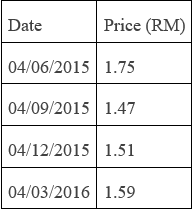
    Price chart from 4th June 2015 to 4th March 2016.

    Let’s say Eddy were to purchase stocks on 4th of June at the price of RM1.75 per unit with RM 10,000. The average cost per unit before transaction fees therefore, would be RM 1.75.

    However, if we used Kent’s approach to investing, he would invest RM 2,500 a quarter with different prices; therefore, his average cost per unit before transaction fees would be RM 1.58.*

    *.(RM1.75 + RM1.47 + RM1.51 + RM1.59)/4 = RM 1.58  

    By having lower transaction fees, Kent is able to obtain more shares for RM 10,000 when compared to Eddy.

    So is DCA the Best Approach?  

    As illustrated above, DCA may allow for outperformance in shorter time frames.

    But even with short and medium term fluctuations, based strictly on long-term results, lump sum investing usually outperforms DCA.

    There are 2 reasons for this.

    1) As we have seen from the first graph, the general trend shows an increase in the price. Thus, the price you first invested at would have been the best choice to make as compared to buying the stock later on in the years at a higher price.

    2) In the grand scheme of the investing time frame, the probability that you will make your lump sum purchase the day (or week or month) before a crash or severe correction is small. If you look back at the DJIA graph, there are relatively few large downward corrections. In other words, the probability of Kent’s worries coming true would be extremely low.

    Put simply, the longer the investment time frame, the greater the benefits would be for a lump sum investment compared to a DCA.

    Less fees in lump sum investing

    Another advantage of lump sum investing would be the transaction costs. Theoretically, this approach should result in less transaction costs when compared to a DCA approach. We will illustrate this using the examples below:

    Eddy’s Transaction Fees:

    Given gross amount of RM 10,000

    *Stamp duty cost for transaction between RM 901 to RM 10000 is RM 10.

    In Eddy’s case, total transaction cost is only RM 25.90.

    Kent’s Transaction Fees:

    Given gross amount of RM 2500 then multiply by 4.

    *Stamp duty cost for transaction between RM 2001 to RM 3000 is RM 3.

    In Kent’s case, total transaction cost is RM 66.08, which is RM 16.52 multiplied by 4.

    Conclusion

    At the end, there is no winning investment strategy formula. It all depends on your risk-taking confidence, as well as your investing style. If DCA (though a seemingly underperforming strategy compared to lump sum investing in this article) suits your investing style, why not give it a go? Who knows, you might end up being richer through a safer approach in your investing career.

    Contributors:
    Researchers – Kent Chong, Eddy Do
    Editor – Luanne Lai

    Download the article here:

    [download id=”2472″]


  • Cryptocurrencies and BlockChain

    Cryptocurrencies and BlockChain

    What Are Cryptocurrencies and the Technology Behind It?

    Like many revolutionary inventions, Cryptocurrency was never meant to be what it is today! In fact, its most iconic form – the Bitcoin – was founded in 2008 by a man shrouded in mystery who goes by the alias Sato Nakamoto. This simple idea of a peer-to-peer electronic cash system has brought the world into frenzy, and with it, a new age of digital consumerism.

    Source: Geekwire.com

    So, what exactly are cryptocurrencies? To put it simply, it is a digital currency that can be transferred between peers without having to go through a central agency. This means that instead of dealing with the bank, your cryptocurrency transaction need only be validated by a peer-to-peer network consisting of computers known as nodes. This process will first verify the transaction and username, and then create a new block of data or combine the date with another block to be inserted into the public ledger as record-keeping,

    Source: Weforum.org

    This almighty public ledger contains information about all the transactions ever done, cryptocurrency or otherwise. Within the ledger, the blocks of data are connected like Lego bricks and they are very much open to the general public. The technology of cryptocurrency systems does not allow users to alter the date in these blocks, and any attempts to alter them will affect other blocks in the same chain. This became a safety feature in the ledger system which had been heavily criticized for its lack of security.

    Almost 10 years since the creation of Bitcoin, cryptocurrencies has been gradually gaining international attention. Other cryptocurrencies, such as Ethereum, Litecoin, and Ripple, work just like conventional money in which different countries have their own currency. What’s more, there are specific exchange rates between different cryptocurrencies and conventional currencies, and they even have their own markets that works just like the traditional stock markets! However, cryptocurrencies has also been thrown into the spotlight for the wrong reasons. One such case is the recent global event where the Wannacry ransomware outbreak demanded for their ransom to be paid in Bitcoins.

    Source: Nascenia.com

    Growth of a New Market, Friend or Foe?

    Nevertheless, a quick search on Google Trends tells us that more people are searching the word “cryptocurrency” in recent years, indicating the growing interest in this unique cash system. And this sector is naturally growing due to the public’s increasing awareness of it.

    The rising interest in cryptocurrencies can perhaps be attributed to how they have adapted to the present demands of market. Cryptocurrencies have certainly come a long way since the days when transacting bitcoins meant dodgy meetings in equally dodgy cafes. These days, one can easily purchase and exchange bitcoins on online(?) platforms like Coinbase. Gold pegged currencies like OneGram coin is exciting many investors, especially within the Muslim crowd as conservative Muslims can present it as fiat money which is not deemed shariah compliant.

    Moreover, the value of cryptocurrencies is more subjected to public perception than most kinds of investments. This has its ups and downs. Bitcoin, for example, is positively influenced by the fact that it is hard to tamper with and hence is perceived to be much safer and less corrupt than the conventional banking system. It is well known that there is a limited amount of Bitcoin that can be mined, specifically, 21 million coins. Due to the finite nature of Bitcoin, the price movement follows the pattern of a limited commodity.

    However, it is negatively influenced by its association with black market transactions due to the perceived anonymity of its currency. The validity or invalidity of the perception has little bearing on its effects. The price decline of Ethereum after news broke that Vitalik Buterin, its co-creator, had died in a car crash, is a testament to the extreme fragility of this perception based system. By the time Buterin had disproved his death one day after the release of the false news, the price of Ethereum had already dropped from 300 USD to 260 USD.

    Concerns About Bubbles and Volatile Price Trends

    Several blockchain-based companies have been able to raise a large amount of capital, usually in tens and hundreds of million dollars, through initial coin offerings (ICOs) even though the company is not selling any products! These investors are pouring their money into the cryptocurrency market with the hopes of gaining instant monetary gratification.

    Due to the mentality of these investors, it is very likely that the prices of the cryptocurrencies will be volatile based on their sentiments and recent happenings in the markets. These investors have no patience and would convert their investments into profits and tangible cash as soon as possible. Indeed, some of these ICOs have no intrinsic value and is merely a gimmick to gain capital. However, it does not deter the investors’ intention to invest in these companies.

    As mentioned before, with the influx of investments in cryptocurrency markets, prices are soaring for certain cryptocurrencies such as Bitcoin or Ethereum. However, the high prices are often not a reflection of the actual value of the cryptocurrency but merely the inflated value stemmed from speculation and questionable market practices.

    A cryptocurrency market is akin to a bubble. When a bubble bursts, it will trigger serious repercussions within any given sector. This concept is similar to a housing bubble, and The most recent bubble burst that we’ve all come to know and fear is the 2008 Housing Crisis. Although it happened in the property sector, its devastating effects are to be feared and learned so that history does not repeat itself.

    Just a month ago, prices of Bitcoin surged past the $3000 mark. While this is treated as a positive news for some investors due to their huge capital gains, there are concerns about the exponential growth of the price and future trends. True enough, in mid July 2017, Bitcoin’s price declined by a big margin, closing at prices around the $1800 mark at one point. Bitcoin’s nearest rival, Ethereum, peaked at almost $400 the same time Bitcoin experienced the decline. It is now fluctuating around the $100 mark and is experiencing high volatility in its prices that may swing within minutes of trading.

    Other than concerns in monetary terms, lack of regulation might lead to fraudulent usage of cryptocurrency as a medium of transaction. Cryptocurrencies can be used for illegal activities or even tax evasion as it is difficult to trace the parties involved in the transaction. Take the Wannacry ransomware attack as an example, hackers demanded ransom in Bitcoins rather than conventional currencies as it would be hard for authorities to trace them. Unregulated markets also meant that security will be loose. Hence, the companies are prone to hackers and malwares, because the only line of defense for these companies will be themselves.

    What Does the Future Hold for Cryptocurrencies?

    Based on the current trend in financial services, financial technology (FinTech) is an area that every relevant institution is investing in for the future. It is strongly believed that digital economy will become the new form of marketplace in years to come. Compared to traditional or fiat currencies, cryptocurrencies are more stabilised in terms of its value and it is also safer due to its blockchain system.

    In the future, cryptocurrencies will no longer be used just for daily transactions in the digital world, but as a store of value because of its limited supply and stability of its value. Until the year 2140, the circular flow will maintain at the amount of 21 million coins. With this limit, Bitcoin will not lose its value due to an oversupply of coins. Compared to a traditional currency note, the central bank or Federal Reserve can increase the money supply by printing more of the notes, which in turn leads to a fall in currency value. With global economy outlook looking uncertain as ever, cryptocurrencies is becoming more popular among potential investors, who find this digital platform more appealing than conventional financial markers because it is free from the geopolitical tensions and business speculations. Hence, the usage of cryptocurrencies is expected to expand in the future.

    On the other hand, cryptocurrencies still might face some competition from conventional financial service providers such as banks that are planning to issue their own types of cryptocurrencies in response to the innovation in FinTech. This poses a threat to all existing digital currency providers. However, it is evident that the new form of currency is gaining recognition from all parties as more attention and resources are diverted into this booming sector. Hopefully, in the near future, cryptocurrencies can completely replace the existing currency systems in every country.

    Currently, cryptocurrency is still outside of government regulations as not much attention was initially given to its development. In recent years, several countries are beginning to establish new monetary regulations pertaining to cryptocurrencies in order to protect users from potential fraud. Despite the tight regulations from government agencies, this will not halt the operations of the digital currency. Intervention from the government, such as operation policies and transaction supervision, can act as a catalyst for consumer sentiment towards cryptocurrencies.

    Summing It Up, Are Cryptocurrencies Good or Bad?

    The key to a successful product is to sustain it in the competitive global markets. Cryptocurrencies can only stay if they are able to explore their strengths more thoroughly, mitigate any risks imposed towards them, and offer solutions to overcome any issues and loopholes in the system. As for now, cryptocurrency markets are still in a bullish state. With the increased popularity of cryptocurrencies among investors, it can be said that the bullish markets are expected to continue for the near future. The timeline below shows the major events that has happened since the creation of cryptocurrencies, with years 2018 and beyond labeled as a question mark for now. Hopefully cryptocurrencies can stand the test of time and emerge as a new trend among financial sectors in the future.

    Prepared by:
    Researchers – Lee Hou Yin, Chong Ker Sun, Marlena Fee.
    Editor – Lim Shu Ni.

    Download the article here:

    [download id=”2366″]

  • Student Financial Aid

    Student Financial Aid

    To pursue a bachelor’s degree in IT in a Malaysian public university costs roughly RM 8,900-RM 9,910 (US$ 2,701-US$ 3,008) on average, and to pursue the same degree in a Malaysian private university costs roughly RM 33,000-RM 43,000 (US$ 8,920-US$ 11,620) on average. Some other disciples might require more than a quarter of a million ringgit in fees! With these fees, especially those exorbitant fees charged in private universities, it is not surprising that many students are constantly on the look-out for student financing.

    The most well-known student financing option in Malaysia is perhaps PTPTN, Perbadanan Tabung Pendidikan Tinggi National as it is accessible by everyone. However, student financing can come in many forms ranging from grants to scholarship to loans to tuition waivers.

    Disrupting Healthcare – Cannabis Will Destroy Big Pharma, Big Alcohol, and Big Tobacco sustanon 350 home – anabolic research winn 50 reviews, anabolic research supplies steroids

    Scholarships

    Student Scholarship for Financial Aid

    Image Credit: Biasiswa.info

    Various institutions offer scholarships and grants to students pursuing an education in specific fields like IT, Medicine, Oil & Gas engineering etc and with different application deadlines. However, most of them are not one-off scholarship and generally have a second opening so it is important not to disregard the scholarships that have already passed their application deadline.

    There are various good websites to search for scholarship, opportunities, and loans. Some notable examples are studymalaysia.com and, of course, the Malaysian Ministry of Higher Education website (www.mohe.gov.my). Both these websites offer a comprehensive list of scholarships along with their detailed specifications such as eligibility, duration, deadlines etc.

    Scholarships are generally of two kinds. One solely covers tuition fees, and the other covers tuition fees and other expenses like accommodation and even allowance to the scholarship holders. Scholarships that cover tuition fees are great, but there is a definite advantage to finding one which covers other expenses as well.

    When applying for scholarships, one of the most important things to keep in mind is whether the scholarship is bonded or not. A bonded scholarship is one which requires the scholarship holder to work for the scholarship provider for a period of time as specified in the scholarship agreement in return for the scholarship.

    Bonded scholarships are commonly perceived as a bad deal on the part of the scholarship holder. However, for those with large financial responsibilities, a bonded scholarship might prove to be a smarter, more economical choice of scholarship. On top of assuring one’s education is paid for, such a scholarship also assures employment upon graduation and a steady income.

    On top of that the issue of whether or not to be bonded, it must be taken into consideration that many scholarships require scholarship holders to maintain a minimum CGPA. If one’s CGPA falls under, say, 3.3, one will not longer be entitled to the scholarship and must seek alternative financing.

    Scholarships with a minimum CGPA requirement can motivate students to perform better and focus more on their studies. With a good CGPA maintained, it is also more likely for these scholarship holders to be eligible for post graduate studies.From the standpoint of the parents, it might be a better option as it provides ample incentive for their children to work harder on their studies.

    Student Loans

    Student Loans Financial Aid

    Image Credit: Tuition.io

    Some of the most popular student loans in Malaysia include PTPTN, KOJADI, and MARA, just to name a few. The specifications for these loans vary pretty largely, so let’s dive in one loan at a time.

    PTPTN

    PTPTN, or “Perbadanan Tabung Pendidikan Tinggi Nasional”, is one of the most common loans students take out for tertiary education. “PTPTN” has almost become synonymous with “student loans”. This loan is aimed at aiding Malaysian students financially by offering them affordable financing at the low rate of 1%. PTPTN is repayable after a six months grace period upon graduation.

    The maximum amount one can borrow with a PTPTN loan depends on the income status of the loan applicant’s family. Students or students with parents who are BR1M receivers are entitled to the Maximum amount of the loan; students with a household income no more than RM8,000 are entitled to 75% of the maximum amount, while students with a household income exceeding RM8,000 are entitled to just 50% of the maximum amount.

    Eligibility

    The eligibility requirements for PTPTN are as follows:

    • Offer letter from an MQA recognised higher education institution
    • Malaysian citizenship
    • Under the age of 45 on the date of application

    Pros and Cons

    One advantage of PTPTN is that there is virtually no barriers for applicants, hence most applicants are eligible for it, making PTPTN is a relatively democratic loan. Another huge pro is that the can be converted to a scholarship if one obtains a Bachelor’s Degree with first class honors. On top of that, the interest rate (Ujrah rate) for PTPTN ranges from only 1% – 3%.

    When it comes to cons, there is one that must be noted when considering which student loan to apply for. PTPTN is, as mentioned above, must be paid back after six months upon graduation based on the amount stated on the contract. The punitive action taken towards those who fail to repay their loans are serious. Those who default their loans will be barred from leaving Malaysia and their passports will be suspended. Their credit records will also be tainted, which destroys their credit reputation and it will be harder for them to borrow in the future.

    KOJADI

    KOJADI, as of now, has up to 13 different loan schemes from loans for early childhood education all the way up to loans for higher education. The interest fees charged on existing members with a minimum membership of 5 years is equivalent to a flat rate of 4.5% whereas the interest rate charged on new members is equivalent to a flat of 5.8%.

    Prerequisites

    The prerequisites for KOJADI loans are as follows:

    • The applicant must be member of KOJADI with RM100 initial shares
    • The applicant / nominee must hold the requisite shares ranging from RM500 to RM1,000 depending on the loan amount applied for
    • The nominated child/nominee must have gained admission to an approved institution of higher learning locally or abroad

    MARA

    MARA is a student loan for Bumiputera students under the Ministry of Rural and Regional Development. MARA loans are applicable to those studying locally as well as abroad. The eligibility for MARA is more or less the same as PTPTN with the additional condition that the applicant must be of Bumiputera status. MARA has a specified list of fields of studies applicants can choose from.

    Fields

    Various field of studies can be eligible for MARA loans/scholarship. This ranges from sciences such as medicine and dentistry, to social sciences and arts disciples such as economics, finance, actuarial science etc. The full list of eligible field of studies is made available here

    Conclusion

    Education can be costly, but there are always alternative financing options students can look into. Picking an appropriate scholarship/student loan can be very tricky. One must keep a lot in mind. The nature and prerequisites of various loans and scholarships vary and it is of paramount importance to read the fine print of the agreement to know exactly what one is getting oneself into.

    [tw-toggle title=”References”]

    Afterschool.my, 2017. [Online]
    Available at: http://afterschool.my/repaying-your-ptptn-loan/
    [Accessed 18 July 2017].

    Afterschool.my, n.d.. [Online]
    Available at: http://afterschool.my/ptptn-loan-a-complete-guide/
    [Accessed 17 July 2017].

    Anon, 2017. [Online]
    Available at: http://www.pendidikanmalaysia.com/2013/03/borang-permohonan-online-biasiswa-mara.html
    [Accessed 18 July 2017].

    CompareHero.my, 2016. [Online]
    Available at: https://www.comparehero.my/blog/what-happens-dont-pay-ptptn
    [Accessed 20 July 2017].

    MOHE, n.d.. [Online]
    Available at: https://www.mohe.gov.my/en/scholarship
    [Accessed 16 July 2017].

    StudyMalaysia.com, 2015. [Online]
    Available at: https://www.studymalaysia.com/education/higher-education-in-malaysia/the-malaysian-higher-education-system-an-overview
    [Accessed 15 July 2017].

    StudyMalaysia.com, 2017. [Online]
    Available at: https://www.studymalaysia.com/international/why-study-in-malaysia/cost-of-studying-and-living-in-malaysia
    [Accessed 16 July 2017].

    StudyMalaysia.com, n.d.. [Online]
    Available at: https://www.studymalaysia.com/scholarships/kojadi-education-loan
    [Accessed 20 July 2017].

    [/tw-toggle]

    Download The Report Here:

    [download id=”2244″]

  • Banks and Us

    Banks and Us

    Introduction

    Some of the largest banks operating in Malaysia

    Banks are defined as financial institutions, where it is licensed to receive deposits from the public and create credit for loans (Bank of England, 2015). The banking industry is an indispensable part of a nation as it contributes to the stability of the economy. Without the presence of banks, it is sure that the economy will not be able to function properly as there is no regulator between individuals and the financial markets, leading to significantly higher risks bear by an individual. To some extent, it may lead to market failure if this goes out of hand.

    Brief Roles of Banks

    One function of banks is to act as a safe for people to deposit their savings and in return provide interest payments to the depositors (ING, 2016). Of course, banks are not pyramid schemes that collect money from new depositors to pay interests to existing depositors, they are profit-oriented organisations as well. To generate profits for themselves, banks collect deposits from the public and invest them into the financial markets. To juggle between the need to make profit and the obligation to pay interest to depositors, banks invest the funds by diversifying them into different pools that suit the needs of the depositors accordingly, be it conservative depositors (fixed deposits) or aggressive investors (investment schemes provided by the bank).

    Besides, banks also offer other goods and services to the general public. For example, debit and credit cards, different schemes of deposits that bear different risks and returns respectively, insurance, and so on. It tries to cater to the different needs of the public while staying competitive compared to the other banks offering similar products (with lower rates, higher returns and etc).

    Banks and Us

    General/Conservative Users

    You might have heard about the occasional “wars” by various banks on the offered interest rates, or how your parents compare the rates of fixed deposits from different banks. Fixed deposit is the safest mean of investment for an individual to participate in as the interest rate is fixed once you deposit your money. It is useful if you have no plans to use your money in the near future, or if you just want to have a minor risk-free investment.

    The most important thing to take note of is the interest rates offered and the term stated with respective to the interest rates. Banks may have promotions that sound attractive at first but further research will reveal that it is not. Therefore, it is essential to find out the total returns with respective to the initial investment for the same period of time while comparing different banks and its promotions.

    For example, Bank A offers 4% per annum as its fixed deposit rate for 12 months while Bank B offers 3.5% per annum for the first 9 months and 5% per annum for the remaining 3 months, a sum total of 12 months. Calculations illustrated below will be based on an initial deposit of RM10,000 and assuming that the fixed deposit is held to its maturity date:

    Bank A (pick this)

    Interest earned = RM10,000 x 4% = RM400

    Bank B (even though the 5% sounds attractive, its short period = less returns)

    Interest earned = (RM10,000 x 3.5% x 9/12) + (RM10,000 x 5% x 3/12) = RM387.50

    Besides that, we are likely to be using the debit and credit cards issued by the banks. Debit cards are received upon the creation of an account in the bank, where it also acts as an ATM card. It is possible to purchase goods with the debit card alone, provided that there is sufficient balance in your bank account and the dealer accept cards as a method of payment.

    Credit cards however are subjected to approval by the bank through applications for it. These cards do not impose a limit to spending based on your account balance, but a limit based on the card itself, hence it is essential for the bank to ensure that the applicant has the ability to pay back the bank after usage. The risk of overspending is significant as the money is invisible, leading to accumulation of credit card debts and bankruptcy if the user is unable to pay back its spending. According to statistics, nearly 50% of bankruptcies caused by credit card overspending are people below the age of 30 (Lim et al., 2014). It is important to be disciplined and control your spending according to your income.

    Business Owners/Potential Business Owners

    If you are a business owner, banks can be of great use to you. Overdraft facilities are available if you need to solve your working capital issues (provided that you can prove to the bank that you can overcome it with a little assistance). Loans are available if you need to expand your business. Equity financing is only available as a source of capital if you are a large corporation (you have accountants/professionals to deal with that anyway when you get to that point).

    For potential business owners, or individuals who are thinking of starting a business, banks may not be the best source of funding for you. Banks usually grant loans to already well-established businesses as there are proven track records. For new start-ups or individuals who wants to promote a new business idea, you are better off finding angel investors or approaching venture capitalists for funding. Both appreciate fresh ideas and are willing to spend money if they think that the idea can yield returns for them in the future.

    Investors

    Commercial banking is only one of the functions of a bank. Large banks are usually conglomerates and investment banks are often a part of it. Hence, investment services are available and banks serve as a middleman between the investor and the financial markets.

    Investment options in Maybank2u, Maybank’s online banking platform

    Taking the example of Maybank, Malaysia’s largest banking group. It has its own online trading platform and brokers for individuals who wants to invest in stocks (only if you open a trading account with them). It has its own unit trusts and the convenience of managing them through Maybank’s online portal. You can even trade gold online by creating a specialised gold trading account with them. Though, since Maybank is offering these services and bringing convenience to the end user, transaction fees will be incurred.

    Conclusion

    Banks are useful institutions to an individual as it serves to bring you convenience by offering services that meet your various needs. It also acts as a safe haven for you to deposit your money (you don’t want to store your money in the form cash under your bed right?) So, the next time when you have some excess cash on hand, why not approach a bank and use their services to your advantage?

    Download The Report Here:

    [download id=”2115″]

    [tw-toggle title=”References”]

    Bank of England. (2015). PRA Rulebook. [online] Available at: http://www.prarulebook.co.uk/rulebook/Glossary/Rulebook/0/03-09-2015/B [Accessed 26 January 2017].

    ING. (2016). The Role of Banks. [online] Available at: https://www.ing.com/About-us/Profile-Fast-facts/The-role-of-banks.htm [Accessed 27 January 2017].

    Investopedia. (2016). Pyramid Scheme. [online] Available at: http://www.investopedia.com/terms/p/pyramidscheme.asp [Accessed 30 January 2017].


    Lim, W., Ng, W., Chin, J. and Boo, A. (2014). Understanding Young Consumer Perceptions on Credit Card Usage: Implications for Responsible Consumption. Contemporary Management Research, [online] 10(4), pp.287-302. Available at: http://www.cmr-journal.org/article/viewFile/11657/pdf_12 [Accessed 1 Feb. 2017].

    [/tw-toggle]

  • What Happens When a Country Goes Bankrupt

    What Happens When a Country Goes Bankrupt

    How Can a Country Go Bankrupt?

    Theoretically and in a perfect world, governments pay their bills using income from taxes and investment. However, just as how we as individuals often spend beyond our means and resort to credit spending, a government does it by issuing bonds with the promise to pay back the value of the bonds with interest rate at its maturity rate. National debt, also known as sovereign debt, consists of internal and external debts. While internal debts constitute of debts owed to those within the country, external debts refer to foreign-currency-denominated bonds issued by the government and sold to foreign investors (Investopedia, 2017). While internal debts can be financed through fiscal and monetary policy-by raising taxes and printing more cash, external debts may divert fund from all other parts of the revenue-generating activities as it needs to be paid using foreign currency, which government has no control over.

    Default happens due to a nation’s inability or unwillingness to repay its debts. The latter often happens when there is a change in governing party of a nation: new government would default on the debt it inherited from its predecessor. There are also various reasons as to why a country defaults on its debt such as simple reversal of global capital flows and weak revenues. For instance, Jamaica’s default on its $7.9 billion loan in 2010 was due to its government overspending and the deterioration of its key sector – tourism.

    “The country goes bankrupt”. That is in fact, a wrong statement. Firstly, a country does not go bankrupt but instead, defaulted on its loan when it fails to repay its debts. Secondly, country does not default, its government does (Abascal, 2015). A nation defaulting on its debts may seem like a rare case, but most countries have defaulted or restructured their debts at least once in their history (The Economist, 2014). Greece was the first country to default on its debt in 377BC, apart from its renowned default of $1.8 billion as being the first developed country to ever default on IMF loan. Since its independence in 1829, Greece has spent around half of its time in defaulting its debt (Bojesen, 2012). Spain, on the other hand, has defaulted the most times: 15 times during the eighteenth to nineteenth century.

    Often, before defaulting on its loans, member countries of International Monetary Fund (IMF) may seek for bailout rescue from IMF, which not only provide financial resources, but the technical expertise to manage the bailout program (Amaro,2017). However, these bailout funding is never a free lunch, as it comes with stringent conditions such as austerity (cutting expenditure), devaluation of currency and trade liberalization, as established in the Washington Consensus.  

    What Happens After a Country Defaults?

    In the event of individual or company bankruptcy, the assets are repossessed by the creditors. During a country’s default however, neither its assets can be seized by its creditor nor can the country be forced to pay with the money it does not have. However, there is no guarantee that this does apply to the country’s assets abroad. This was the case when Argentina’s navy training ship which was then in Ghana, was seized when Argentina defaulted in 2012.

    The only recourse for the creditor of the defaulted country is to renegotiate the terms of the loan. Government bonds will be rescheduled for deferred payment or underwent ‘haircut’, which involves reducing the value of bonds. After its $81 billion default in 2011, Argentina offered to pay its creditors a third of what it owed. In this regards, 93% of the debt was swapped for performing securities in 2005 and 2010, and not only until 2016 that Argentina repay 85% of the remaining debt held by vulture fund for 75% of its original value (Blitzer, 2016).

    What Are the Effects of Defaulting?

    The immediate cost of defaulting is the loss of principle and capital of creditor resulting from either partial debt cancellation or debt restructuring. Among the debt owed to different creditors: domestic private creditor, domestic institutional creditor, foreign private creditor and foreign institutional creditor, the government is most likely to cancel debts owed to foreign private creditor due to the less likely retaliation. Besides, just as any other crisis, soaring inflation, unemployment and political pressure to the defaulting government follow as a result of government defaults.

    As most of the domestic debt is held by domestic banks, bank runs occur due to the loss of confidence in the banking system. Bank runs occurs as there is massive withdrawal of money due to public panic and loss of confidence. To prevent this, capital control is imposed as government try to restrict the amount of money that can be withdrawn by each depositor. In June 2015, Greek banks were closed for almost 20 days, bank transfers to foreign banks were controlled and cash withdrawals were limited to only €50 per day to avoid banking crisis. Sovereign debt crisis may also lead to subsequent economic crisis and currency crisis as aggregate demand fall and international market lost faith in its currency.

    Another effect that is certain about a defaulted country is its lost of accessibility to the credit market. Punitive rate is imposed on its loan or in most cases, it will not get the loan at all. Credit rating of defaulted country will be affected, deterring foreign investment in the country.

    An Opportunity for Investing?

    Default deters domestic and foreign investment. However, the fall in assets prices and exchange rate of the defaulted country has made these assets easily affordable for foreign investors. This may signify investment potential in the defaulted country. There are also investors who see default as the perfect time to invest. Vulture funds seek to profit from the crisis by mass purchasing high yield (high risk) bonds of the near-default or defaulted country at highly discounted price and anticipate rebound on its values as the country recovers. However, it carries risks as to whether there will be a rebound in the asset prices in the defaulting economy, or if the recovery is worth the wait.

    Is Defaulting the Only (Best) Way Out?

    Due to the cost of default, a country will choose to default only if it is better off not paying its debts. In Argentina, many think that default was the best thing to happen. After the peso plummeted, Argentina product becomes more competitive in the international market. The inflow of money lead Argentina to its recovery. In addition, evidence suggests that the adverse effects of default are rather short-lived. The borrowing cost due to downgraded credit ratings lasts about 2-7 years, the loss in economic growth may be picked up in few years’ time and the loss of confidence may eventually be regained. The effect of default will be less substantial if it relies less on foreign loans as it is able to soothe out these effects through implementation of monetary and fiscal policy.

    Defaulting on loan may be a boon than a bane for a heavily indebted country despite its consequential effects. As Paul Blustein, author of And the Money Kept Rolling In (and Out): Wall Street, the IMF, and the Bankrupting of Argentina has put it: In the long run it will be better for the country than if they had tried to struggle on and pay debts that were too great a burden for the economy to bear” (NPR, 2011).

    Download The Report Here:

    [download id=”2109″]

    [tw-toggle title=”References”]

    Abascal, E. (2015). What does it mean for a country to default?. [online] IESE Business School. Available at: http://blog.iese.edu/economics/2015/03/04/what-does-it-mean-for-a-country-to-default/ [Accessed 1 May 2017].

    Amaro, S. (2017). IMF moves a step closer to joining Greek bailout, sources tell CNBC. [online] CNBC. Available at: http://www.cnbc.com/2017/03/17/imf-moves-a-step-closer-to-joining-greek-bailout-sources-tell-cnbc.html [Accessed 1 May 2017].

    Blitzer, J. (2016). A Good Week for Vulture Funds. [online] The New Yorker. Available at: http://www.newyorker.com/business/currency/a-good-week-for-vulture-funds [Accessed 1 May 2017].

    Bojesen, L. (2012). History of Defaults: Greece Did It First; Spain Most Often. CNBC. Available at: http://www.cnbc.com/id/47814564 [Accessed 1 May 2017].

    Investopedia. (2017). Sovereign Debt. [online] Available at: http://www.investopedia.com/terms/s/sovereign-debt.asp [Accessed 1 May 2017].

    NPR. (2011). When A Country Defaults, Who Comes Knocking?. [online] Available at: http://www.npr.org/2011/10/09/141195893/when-a-country-defaults-who-comes-knocking [Accessed 1 May 2017].

    The Economist. (2017). The Economist explains : What happens when a country goes bust. [online] Available at: http://www.economist.com/blogs/economist-explains/2014/11/economist-explains-20 [Accessed 1 May 2017].

    [/tw-toggle]

  • Ponzi Schemes

    Ponzi Schemes


    The Fall of JJPTR

    The alleged cyberattack on the forex-investing entity, JJPTR has garnered nationwide attention towards the illegal investment scheme during late April. Investors panicked as they saw their capitals frozen along with the shutdowns of all office branches. The incident purportedly caused a massive loss of RM500 million in malicious forex trades. Unsurprisingly, the statement was met with public scepticism, with most pointing out obvious red flags and labelling the scheme as a Ponzi scam.

    Since 2015, JJPTR has been proclaiming itself as an investment company that promises its’ investors a monthly 20% Return on Investment (ROI) on their capital, with a maximum cap that increases as membership matures. Additionally, members are also offered a 5% monthly commission on capitals of recruits. Despite being placed on Financial Consumer Alert list by Bank Negara Malaysia, the company continued to rise in popularity.

    A Glimpse into Ponzi Schemes

    Regardless of the authenticity of JJPTR, Ponzi schemes are not new occurrences in Malaysia. Ponzi scheme is a fraudulent investment structure where dividends paid for early members are funded by capitals from newer members. It is difficult to tell apart Ponzi schemes from legitimate investment plans on the surface as no Ponzi scheme have ever labelled itself as one anyway. However, Ponzi schemes have generally offered absurdly high ROI – some even reaching a monthly 40% rate with abnormal consistencies. Comparing this rate to renowned investors such as Warren Buffett (Berkshire Hathaway), who managed to generate an average of 20.3% annual return on stocks to investors, it is difficult to see how these schemes’ managers have not topped Forbes World’s Billionaire list.

    Complementing the high return rate is also the commission system, where upliners will be paid additional dividends on the capital brought in by their recruits. This generates a continuous entry of funds into the system. Eventually, the input of funds is insufficient to support the dividends of prior investments, the operators escape while reaping huge profit out of it. It is only a matter of time before a new similar scheme with different name emerges. However, on closer inspection, the modus operandi remains largely similar.

    The Case for Unregulated and Unauthorised Tradings

    According to Bank Negara Malaysia, Bitcoin has yet to be recognized as a legal tender in Malaysia. As in the case of foreign exchange, aside from commercial and Islamic banks, BIMB Foreign Currency Clearing Agency Sdn Bhd and RMEX Trading Sdn Bhd are the only clearing houses authorised to conduct foreign currency trading. These make investing in these vehicles in Malaysia ambiguous.

    The lack of strict regulations and exploitation of legal loopholes still make way for citizens to trade in these currencies. For instance, the modus operandi for forex-trading entities is to siphon the money to company offshore where foreign exchange trading is legal. The effect is the inability of local authorities such as Bank Negara Malaysia and Securities Commision Malaysia to prosecute them with illegal deposit taking. Thus, the entire structure becomes opaque due to the lack of legal documentations and identity.

    Fraudulent companies have been known to set up their own servers which they could manipulate and trick investors into believing they’ve reaped huge profits. Despite these companies being placed on watchlists by central banks, consumers would often continue engaging as it is easy to claim that the enlisting were simply due to the illegal yet profitable nature of the activities. These same concepts apply equally on Bitcoins and other unregulated currencies. The lack of transparency within these self-proclaimed investment entity allows schemes operators to easily deceive unaware financial consumers into believing their legitimacy.

    The Genneva Gold Futures Scandal swept an estimated RM5.5 billion deposits of 35,000 investors. The venture responsible, Geneva Sdn Bhd, resembled that of a Ponzi scheme and was charged with more than 1000 counts of charge including money laundering, tax evasion, misrepresentation and appointments of agent without license. The scam peaked at a time when economic uncertainties were at its’ highest in 2008 during the subprime mortgage crisis, and when gold trading was an unregulated activity with no licensing and approvals required.

    How Consumers Can Protect Themselves?

    It is best that one only engages in licensed financial activities from regulated financial institutions in Malaysia. All legitimate investment schemes should come with a prospectus from Securities Commission that must be produced to protect investors.

    While this article does not condemn the act of investing in unregulated commodities, it should be made known that these investment scenes have dreadful propensity for fraudulent entities to exploit the loopholes. Hence, financial consumers should look for obvious red flags before engaging. Amongst these are abnormally high interest rates and ROI, high frequency of dividend payments, purported dealing in unregulated and obscure currencies, multi-leveled marketing system, guaranteed returns, companies enlisted on Financial Consumer Alert List and have neither registrations, verifications by authorities nor financial statements released to investors and the feature of a charismatic spokesperson setting up irrelevant businesses in the region. Investors attempting to trade in foreign currencies through a company should communicate with relevant regulatory agencies in the country to verify the credibility of forex brokers.

    According to FMT News, the relevant regulatory agencies for respective countries are National Futures Association (NFA) and Commodity Futures Trading Commission (CFTC) in the United States, Financial Conduct Authority (FCA) and Prudential Regulation Authority (PRA) in the United Kingdom, Australian Securities and Investment Commission (ASIC), Swiss Federal Banking Commission (SFBC), Bundesanstalt für Finanzdienstleistungsaufsicht (BaFIN) in Germany and Autorité des Marchés Financiers (AMF) in France. All in all, when making investments, the simplest way to protect yourself is to avoid decisions that are ‘too good to be true’.

    Download The Report Here:

    [download id=”1912″]

    [tw-toggle title=”References:”]

    “Report: Unauthorised Forex Trader’S Collapse May Cost Punters Half Billion”. Themalaymailonline.com. N.p., 2017.  Maxfield, John. “An Interesting Chart About Berkshire Hathaway — The Motley Fool”. The Motley Fool. N.p., 2017.  Mohd Sulaiman, A, Moideen, A, & Moreira, S 2016,

    ‘Of Ponzi schemes and investment scams’, Journal Of Financial Crime, 23, 1, pp. 231-243, Business Source Complete, EBSCOhost, viewed 28 April 2017.

    Firdaws, Nawar, and Minderjeet Kaur. “More Young M’Sians Falling Prey To Forex Schemes”. Free Malaysia Today. N.p., 2016. Web. 28 Apr. 2017.

    [/tw-toggle]

Subscribe to us now!

Interested in achieving financial literacy?